

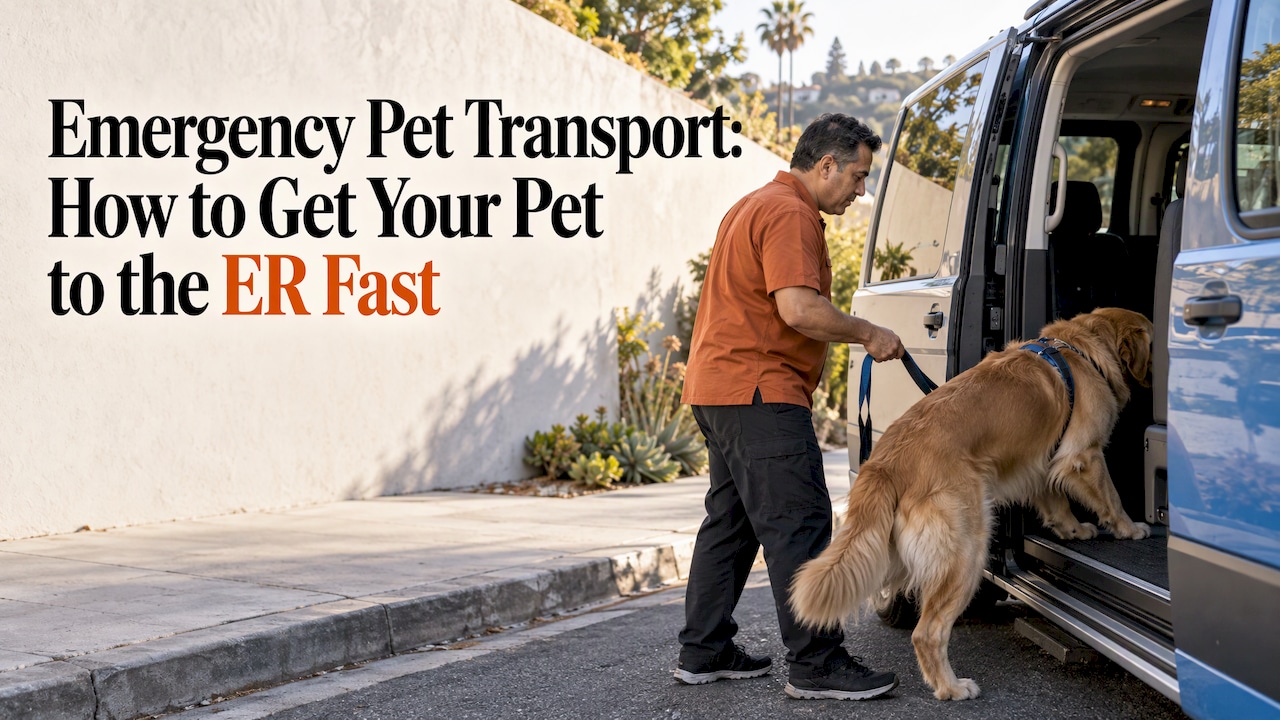
If your pet is in a true emergency, call the nearest veterinary emergency hospital first, then get your pet there by the fastest safe route. That may be your own car, a friend’s, or a private pet transport driver when you have no car, can’t drive and handle your pet at once, or have a large dog you can’t lift. This guide covers how to decide, how to prepare your pet for the ride, what to ask any transport service, and how our emergency rides work in Los Angeles and Southern California.
TL;DR
- Call a veterinary emergency hospital first. Tell them your pet’s signs and that you are on the way so the team can prepare.
- Never put yourself at risk: restrain a hurt or frightened pet safely before you move it, and support the spine and neck if you suspect trauma.
- A private pet transport driver is for getting your pet to the clinic when you can’t. It does not replace veterinary care.
- Ask any service about availability, large-breed handling, whether the same driver will stay with your pet, how it keeps you updated and how pricing works before you need it.
- Our after-hours and emergency rides add a $40 fee. Large breeds (50+ lbs) add $25.
Table of Contents
- When to treat it as an emergency
- Who to call first
- What emergency pet transport actually is
- How to keep your pet safe before the ride
- What to ask any pet ambulance or transport service
- Our perspective
- Emergency vs. non-emergency pet transport
- What our rides cost
- Book a ride for your pet
- Build your emergency plan now
- FAQ
- Sources
When to treat it as an emergency
The short rule: if you are asking yourself whether it is serious, call a clinic and describe what you see. The clinic’s triage staff would rather hear from you early.
The ASPCA lists severe trauma, choking, heatstroke, poisoning, pale gums, rapid breathing, difficulty standing, paralysis, loss of consciousness, seizures and excessive bleeding as reasons to seek emergency care. The University of Wisconsin veterinary school adds the inability to urinate, nonproductive retching or repeated vomiting, eye injuries, difficult labor, severe lethargy and a distended abdomen.
Common real-life examples:
- A dog hit by a car or fallen from a height, even if it seems to walk normally afterward.
- A cat straining in the litter box without producing urine.
- A large dog with a swollen, hard belly and unproductive retching.
- A pet that ate something toxic, such as medication, chocolate or rodent poison.
- A seizure, collapse or sudden trouble breathing.
Who to call first
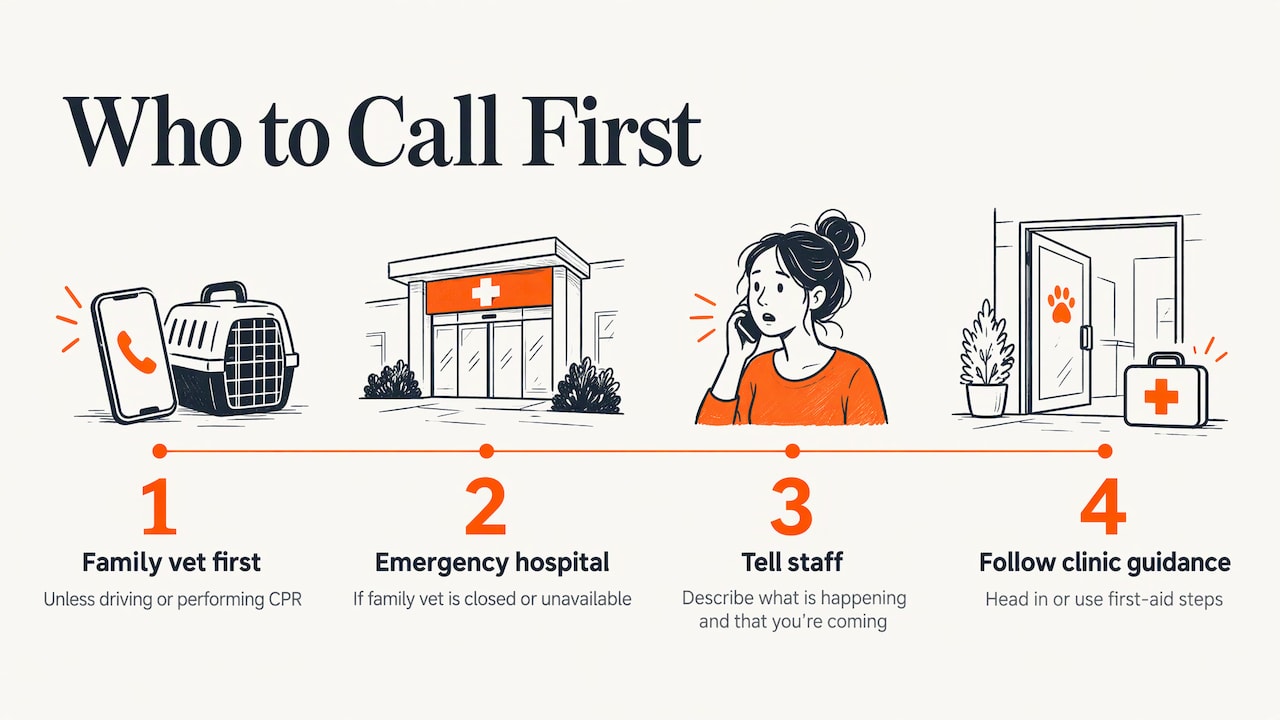
Call before you drive. One emergency hospital recommends calling your family vet first, and if they are closed or unavailable, calling the local emergency hospital. Tell the staff what is happening and that you are coming, so they can get ready.
One exception: Zoetis notes that if you are the one driving or performing CPR, focus on that and on reaching the clinic rather than calling ahead. That is a good reason to have a second person, or a driver, on the way.
The clinic can also tell you whether to head straight in or give first-aid steps for the next few minutes. Emergency hospitals have emergency-care experience, equipment and advanced diagnostics, and they are typically open when primary-care vets are closed. That is where your pet needs to end up.
What emergency pet transport actually is
People search for “animal ambulance” or “pet ambulance near me” and get a mix of services. They fall into roughly three types:
- Medical pet ambulances. Vehicles staffed or equipped for in-transit medical care, sometimes run by a veterinary hospital. They are the right tool for the most critical patients and some hospital-to-hospital transfers.
- Hospital-run shuttles. Some clinics move patients between a referring practice and their own hospital on a set schedule.
- Private pet transport. A dedicated driver takes your pet from home to the vet, ER, groomer or airport. This is what we do. We drive your pet to the hospital and keep you updated on the way. The veterinary team provides the medical care.
If your pet is unconscious, not breathing or bleeding heavily, speak to the emergency hospital right now and follow their instructions about the fastest way in. Don’t spend those minutes comparing services.
How to keep your pet safe before the ride
Your own safety comes first. Hurt animals bite and scratch, even gentle ones. The MSD Veterinary Manual advises restraining the pet before giving first aid. Its guidance on small animals includes:
- Most dogs can be muzzled with fabric, but not if they have facial injuries or are struggling to breathe.
- Cats can be placed in a dark box.
- If head, neck or spine trauma is possible, support the animal on a flat, firm surface.
A few practical habits help on top of that:
- Keep it calm and quiet. Dim light and a low voice reduce stress.
- Use a carrier for cats and small pets. A secure carrier keeps a frightened animal from escaping in a car.
- Bring information. Medication names and doses, vaccine records if easy to grab, and what your pet may have eaten, with the packaging if it was a toxin.
- Don’t give human medication. Ask the clinic first.
- Don’t hold a large dog in your lap. Give the driver a clear plan for how the dog will lie in the vehicle.
The American Veterinary Medical Association’s policy on animal transport stresses practices that minimize stress and protect both animals and the people handling them. That is the standard we aim for on every ride.
What to ask any pet ambulance or transport service
Use this list to compare services in your area, ideally when your pet is healthy, so you already know whom to call.
| Question | Why it matters |
|---|---|
| Are you available at night, on weekends and on holidays? | Emergencies rarely happen between 9 and 5. |
| Do you take large dogs? | Many services turn away big breeds or have weight limits. |
| Is the ride private? | Shared rides mean a longer trip and more stress for your pet. |
| Who handles my pet? | Consistent handling matters for anxious or injured animals. |
| How will I get updates? | You will want to know your pet has arrived and been handed over. |
| How is pricing set? | Ask what distance, time of day, pet size and waiting time add. |
| Are you licensed and compliant? | See the next section. |
Licensing in California
A California Veterinary Medical Board information sheet states that pet ambulance services are regulated by existing California regulations and by the business licenses of the local jurisdiction. Ask any provider about its business license and what it is permitted to do for your pet, and ask your vet or emergency hospital if you need advice about a service.
Our perspective
We built Pets Go Taxi around the rides other services turn down: the 90-pound dog that can’t be lifted into a sedan, the anxious cat that has already had a rough night, the 11 p.m. call from an owner with no way to get to the ER.
In an emergency, three things matter to the owner: that someone picks up, that your pet is treated gently, and that you aren’t left guessing. So every ride is private. The same experienced driver handles your pet from pickup to handoff, and you get updates along the way. Your pet is never passed to a stranger or put in a shared ride.
We accept large breeds. We specialize in anxious and special needs pets. We are available after hours, because that is when emergencies happen.
My advice is the same one I give every owner: call the emergency hospital first, then call us if you need a safe ride there. Save our number now, because the worst time to search for a driver is during a crisis.
Brian
Emergency vs. non-emergency pet transport
Once the crisis is over, or when the problem is planned, the same driver can help with the rest of your pet’s care:
- Follow-up visits. After a hospital stay, your pet may need rechecks, suture removal or specialist appointments. A calm ride matters most when your pet is recovering.
- Vet appointments. Regular visits, vaccines and diagnostics for owners with a busy schedule, or a pet that is hard to get into a car.
- Airport transfers. Rides to and from LAX and other airports for pets traveling or arriving.
- Grooming and daycare drop-offs.
- Long-distance trips. Specialty hospitals can be hours away. We drive from Los Angeles to Santa Barbara, Palm Springs, San Diego, San Francisco and Sacramento.
When the plan is non-emergency, book ahead and tell us about your pet’s size, temperament and any medical needs so we can plan the ride.
What our rides cost
Pricing depends on distance, pet size, timing and extras, and we quote each job individually. These are the published rates on our site:
| Item | Price |
|---|---|
| Local pet rides | from $100 per ride |
| Additional miles beyond 10 | $3.50 per mile |
| After hours / emergency | $40 |
| Large breed (50+ lbs) | $25 |
| Rush hour (AM/PM) | $25 |
| Driver wait time | $65 per hour |
Emergency Pet Transport and Airport Pet Transfers don’t have a set published price. Contact us with the pickup address, the hospital and your pet’s size, and we will give you a quote.
A worked example: a local ride for a 70-pound dog at night, within 10 miles and outside rush hour, would be the $100 base ride, plus $25 for the large breed and $40 for after hours, which makes $165 before any wait time. Your final quote is confirmed with us when you book.
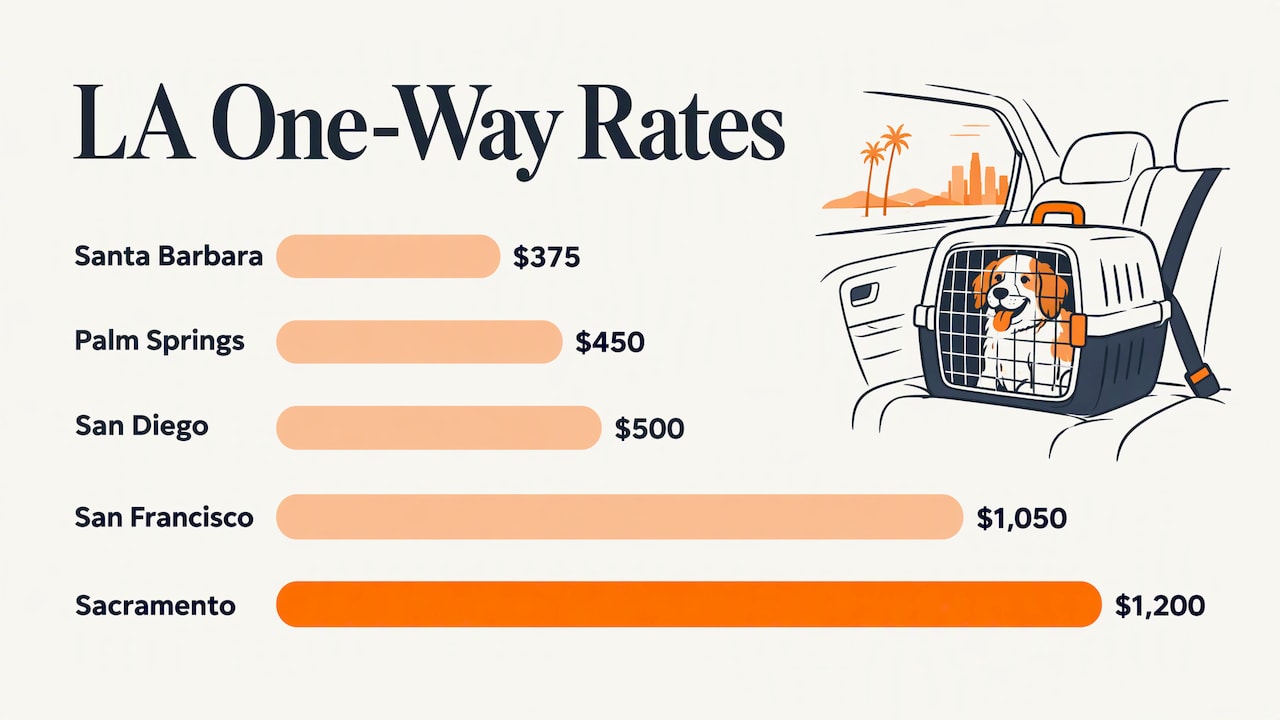
For longer drives, the published one-way rates from Los Angeles are $375 to Santa Barbara, $450 to Palm Springs, $500 to San Diego, $1050 to San Francisco and $1200 to Sacramento.
Book a ride for your pet
If you need a private driver who takes large breeds and is available after hours, see our Emergency Pet Transport and Airport Pet Transfers page, or start from our local pet ride rates. Every ride is private, handled by the same experienced driver, with real-time updates to you.
If you are caring for a pet recovering at home after an emergency, our drop-in pet sitting covers feeding, medication administration ($10 per visit add-on), condition checks and photo updates, at $50-75 per visit.
Build your emergency plan now
A few minutes on a calm day save time on a bad one:
- Save two numbers: your nearest 24-hour veterinary emergency hospital and your regular vet.
- Know the route and the drive time to the ER from home, including at rush hour.
- Keep a carrier ready for cats and small pets, and decide how your large dog will travel.
- Keep a folder of vaccine records, medication list and any chronic conditions.
- Save a transport contact you can call at night.
- Tell your driver in advance about your pet’s size, temperament and special needs.
FAQ
Should I call a pet ambulance or the emergency vet first?
Call the emergency vet or hospital first. They can advise whether to come in at once and what to do on the way, and they can prepare for your arrival. Then arrange the fastest safe transport if you can’t drive yourself.
Can you transport large dogs in an emergency?
Yes. We accept large breeds that other services often turn away. A large breed (50+ lbs) adds $25 to the ride. Tell us your dog’s approximate weight and the pickup situation when you call.
Do you operate after hours?
Yes. We are available for after-hours and emergency rides, with a $40 after hours / emergency fee. Because Emergency Pet Transport is quoted individually, call us with the pickup and destination for a price.
Will my pet ride with strangers or other animals?
No. Every ride is private and handled by the same experienced driver, and we send updates to you in transit.
What should I bring to the ER?
Bring any medications your pet takes, vaccine records if you can grab them, and the packaging of anything your pet may have eaten. If your pet is a cat or small animal, use a secure carrier.
Sources
- Emergency Care for Your Pet, ASPCA
- When to Seek Emergency Care for your Pet, University of Wisconsin School of Veterinary Medicine
- Transporting Pets to the Animal Emergency Hospital
- How Do Emergency Vet Clinics Work?, Zoetis Petcare
- First Aid and Transport of Small Animals, MSD Veterinary Manual
- Transportation of animals, American Veterinary Medical Association
- Pet Ambulances: Information for Pet Owners, Veterinary Medical Board of California