

The best way to care for a cat while you travel is to keep her at home and have a trusted sitter visit on a set schedule. Cats are creatures of routine and feel safest in familiar surroundings, and a sitter keeps feeding, litter and health checks on track while you are gone. Any trip longer than a day needs a plan. We offer drop-in pet sitting in Los Angeles, with visits that include feeding, litter box cleaning, condition checks and photo updates. The rest of this guide covers how often to visit, how to prepare, and what to leave for the sitter.
TL;DR
- Healthy adult cats can usually manage 8 to 12 hours alone. Past 24 hours, someone should check on your cat regularly.
- For a trip longer than 10 days, the San Francisco SPCA suggests a sitter who can spend the night at least a few times a week.
- Staying home is usually easiest on a cat, because boarding means unfamiliar people, animals and routines.
- Before you leave, hold a meet-and-greet, set up a safe room, and write down routines, medications and vet contacts.
- In Los Angeles, a drop-in visit with us costs $50-75 per visit, with a $10 medication add-on and from $15 for each additional pet.
Table of Contents
- How long can a cat be left alone?
- A simple visit schedule by trip length
- Home sitter or boarding: which is easier on a cat?
- Do cats get sad when you leave?
- Before you go: prepare your cat and your home
- What to leave for your sitter
- Vet, ID and emergency arrangements
- Our view: why consistent visits beat clever gadgets
- What drop-in cat sitting costs in Los Angeles
- Book care for your cat
- FAQ
- Sources
How long can a cat be left alone?
The short answer: hours, not days. PetMD, in a piece by Hannah Hart, DVM, says healthy adult cats can typically be left alone for 8 to 12 hours. It adds that if you will be away for more than 24 hours, someone should check on your cat regularly. Hill’s Pet takes a similar line. It treats 8 to 12 hours as safe for most healthy adults and 24 hours as occasionally acceptable if food, water, a clean litter box and a safe environment are in place. It says 48 hours should be avoided unless absolutely necessary.
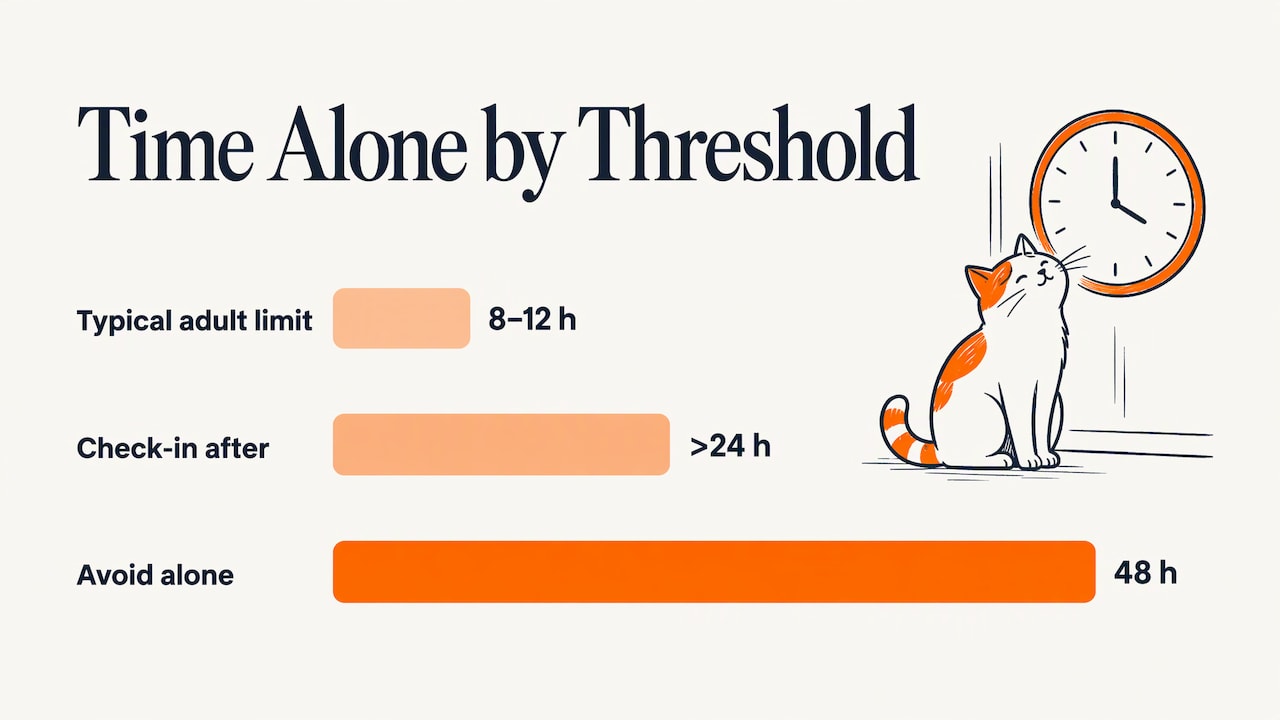
The San Francisco SPCA draws the line a little tighter. It says not to leave your cat alone for more than 12 hours without someone to check on them.
Your own cat matters more than any rule of thumb. Age, health, personality and household all change the answer, and PetMD notes that kittens need much more frequent supervision than adults. A senior cat on kidney medication and a confident two-year-old are not the same case.
Can you leave a cat alone for two weeks?
Not without help. Two weeks alone with a feeder and a big bowl of water is the version of this plan that goes wrong. Food can spill or spoil, water can get fouled, litter fills up, and nobody notices if your cat gets sick or stuck somewhere. The San Francisco SPCA advises that for trips of more than 10 days, it is best to have a sitter who can spend the night at least a few times a week. For a two-week trip, plan on daily visits at the very least, and consider overnight stays on top of that.
A simple visit schedule by trip length
Use this as a starting point and adjust for your cat’s age and health. It combines the guidance quoted above with the way sitting visits usually work.
| Time away | What to arrange |
|---|---|
| Up to 12 hours | Usually fine for a healthy adult with food, water and a clean litter box |
| 12 to 24 hours | A check-in is wise, especially for kittens, seniors or cats with health conditions |
| 1 to 3 days | At least one visit a day, and two for a young, elderly or anxious cat |
| 4 to 10 days | Daily visits with feeding, litter cleaning and a look at how your cat is eating and moving |
| More than 10 days | Daily visits plus a sitter who stays overnight a few times a week |
A visit is more than a bowl refill. A good sitter scoops the litter box, checks that your cat is eating and drinking normally, and notices when something is off. That is the part a timed feeder cannot do.
Home sitter or boarding: which is easier on a cat?
Cats have three common options while you are away: stay in your home with a sitter, stay at another person’s home, or go to a boarding kennel. For most cats the first is the gentlest.
The Ohio State University Indoor Pet Initiative points out that boarding puts a cat in unfamiliar surroundings, with unfamiliar people and animals, away from her normal schedule. The American Humane Society says in-home sitting with drop-in visits works well for cats and for pets that do better in their own environment. The San Francisco SPCA recommends keeping your cat’s lifestyle as stable as possible, ideally at home, because cats feel safest in familiar territory.
In practice, staying home means:
- Her food, bowls, litter box, perches and hiding spots stay exactly where they are.
- Her meal times stay close to normal, which matters because the American Association of Feline Practitioners notes that changes in feeding times and household activity can affect a cat’s emotional state.
- There is no carrier ride, no strange smells and no new animals in the next room.
- You get a daily photo and note instead of silence.
One exception is worth knowing. VCA Animal Hospitals says pets that need vigilant monitoring of a medical condition or complicated daily therapy should be under veterinary supervision. If your cat falls into that group, talk to your veterinarian before you book travel.
Do cats get sad when you leave?
Some do, and it is worth planning for. A 2017 study by Eriksson, Keeling and Rehn found that cats purred and stretched more after a four-hour separation than after 30 minutes, and owners spoke to them more on returning. The authors read that as cats being affected by how long they are left alone. Catster reports, in a vet-reviewed article, that most cats show some signs of stress when their owner is away, especially strongly bonded or routine-sensitive ones.
What that looks like at home: hiding, crying or yowling, eating less, or urinating outside the litter box. Those are exactly the things a visiting sitter can spot and report to you, and they are a reason to want a daily check, not an occasional one.
Before you go: prepare your cat and your home
Most problems with sitters come from surprise. A cat who has never met the person who walks in will often vanish under the bed. Spend a little time on the following well before your departure date.
Introduce the sitter early
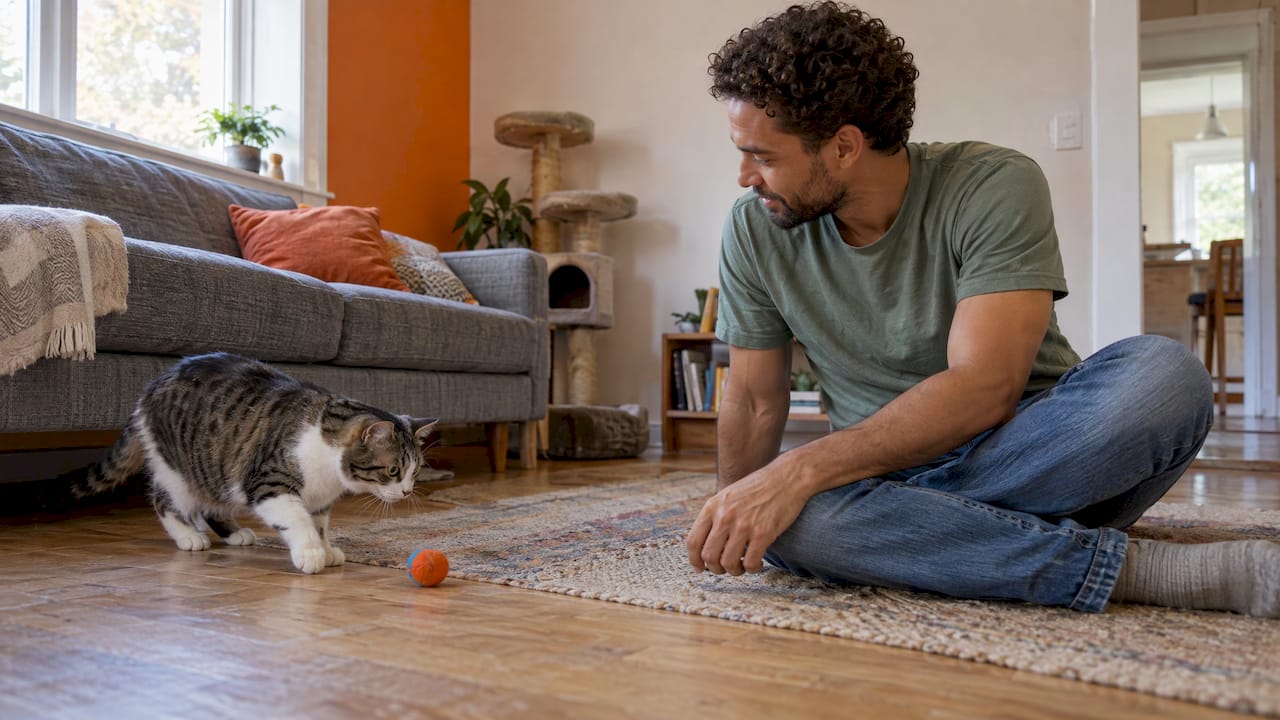
The Ohio State University Indoor Pet Initiative recommends introducing the sitter to your cat a few weeks ahead and setting up play sessions so the cat links the sitter with good experiences. The Peninsula Humane Society & SPCA suggests a meet-and-greet before the trip, a walk-through of the daily routine, and a trial run a week or two before you leave.
Set up a safe room
The American Humane Society recommends a safe room with food, water, litter and a hiding option ready before the sitter arrives. It notes that some cats will never come out from under the couch for a stranger. The goal is access to basic needs, not forced socializing. If your cat is shy, tell your sitter that a quiet visit where she eats, drinks and uses the box counts as a good one.
Leave comforting cues
The Indoor Pet Initiative suggests giving your cat a refuge, leaving a piece of clothing or blanket with your scent on it, and playing a radio or TV quietly near it for calming background noise.
Keep the goodbye short
The American Humane Society says long, emotional goodbyes can heighten anxiety in dogs, and that a calm, matter-of-fact exit tends to go more smoothly. Treat your cat the same way: skip the drawn-out farewell and leave at an ordinary time of day.
What to leave for your sitter
Write it down. The Peninsula Humane Society & SPCA suggests a daily routine and emergency list covering what your cat eats and drinks, any treats or medications, step-by-step instructions for giving them, where the litter box is, what litter she prefers, and where to dispose of soiled litter.
The ASPCA adds that the sitter should have your pet’s age, weight, current health issues, medications, regular diet and microchip information. They should also have your regular veterinarian’s contact, the nearest emergency clinic and the ASPCA Animal Poison Control Center number, 888-426-4435.
A one-page sheet works well:
- Feeding: amounts, times, brand, and treats allowed.
- Medication: name, dose, time and how your cat takes it.
- Litter: type, location, and where to dispose of it.
- Hiding spots, and which rooms are off limits.
- Normal behavior and the signs that mean you should be called.
- Your regular vet, the nearest emergency clinic, and your travel contact details.
Vet, ID and emergency arrangements
Three things belong on your list before you leave.
- Identification. The Merck Veterinary Manual says identification should be on a collar or carrier, and ideally in a microchip that scanners at veterinary hospitals and shelters can read. Make sure your chip registration has a phone number that works while you travel.
- Your vet. The ASPCA recommends telling your veterinarian when you will be gone or out of reach, and naming who is authorized to make decisions about your pet in your absence.
- A way to get to the clinic. If a cat needs urgent care while you are away, the sitter needs a plan that does not depend on you being reachable. A cat in distress should not travel on a rideshare or in a borrowed car with no carrier. We run emergency pet transport with after-hours availability, and we explain what a sitter should do in our guide to emergency transport when a sitter needs help.
If your cat shows serious signs of illness such as labored breathing, repeated vomiting, not eating or not using the litter box, the sitter should contact your veterinarian or an emergency clinic right away.
Our view: why consistent visits beat clever gadgets
Cat owners often ask us whether an automatic feeder and a long weekend will do. Our answer is to think about who will notice if something changes. A feeder drops food at a set time. It will not see that your cat is hiding, limping, or skipping meals.
We built our in-home care around that difference. Our drop-in visits cover feeding, litter box cleaning, condition checks, medication, companionship and photo updates, and they keep your cat in her own home with her own routine. That is what the research on cats and routine points to, and it is what we would want for our own animals.
When a cat does need to go somewhere, such as a vet appointment or a trip to the airport, we handle that too. Our rides are private, and your pet is never handed off to strangers or put in a shared ride. You get updates while you are away.
Brian
What drop-in cat sitting costs in Los Angeles
Our drop-in pet sitting is priced per visit, and the figures below are as published on our site in 2026.
| Item | Price |
|---|---|
| Drop-in visit | $50-75 per visit |
| Additional pet | from $15 per pet |
| Medication administration | $10 |
| Weekend | from $15 |
| Holiday | $25 |
A visit includes feeding, litter box cleaning, condition checks, companionship and photo updates. As a worked example, a week of daily visits at the listed range comes to between $350 and $525 before any add-ons. Add medication, a second cat, or a holiday date and the total moves accordingly. Check the sitting page for the current rates.
Book care for your cat
If you are planning a trip, the simplest next step is to set up visits at least a few weeks ahead, so your cat can meet her sitter before you leave. We offer in-home drop-in visits across Los Angeles, plus private rides for cats to the vet, groomer or airport. You can see our drop-in pet sitting or read about pet transport for cats in Los Angeles.

Airport transfers and emergency rides are quoted individually, so contact us through our services page with your dates.
FAQ
Can I leave a cat alone for a weekend?
For most healthy adult cats, a weekend is too long to leave without a visit. Hill’s Pet says 24 hours is occasionally okay with food, water and a clean litter box, and that 48 hours should be avoided unless truly necessary. Plan at least one visit a day, and two for kittens, seniors or cats with medical needs.
Do people board cats when they go on vacation?
Yes, some do. But cats are creatures of routine, and boarding takes them away from their own surroundings and schedule. Many owners find that visits at home are easier on the cat, especially for shy or older animals.
What should a cat sitter do during each visit?
A sitter should feed your cat as you instruct, refresh water, clean the litter box and give any medication. They should also look over your cat and let you know about changes in appetite, behavior or litter habits. Our drop-in visits include feeding, litter box cleaning, condition checks, companionship and photo updates.
How far ahead should I book a sitter?
Book early enough to fit in a meet-and-greet and, ideally, a trial visit a week or two before your trip, as the Peninsula Humane Society & SPCA suggests. Holidays and weekends tend to fill up, so earlier is better.
Sources
- Traveling (Cats), San Francisco SPCA
- How Long Can You Leave a Cat Alone?, PetMD
- How Long Can You Leave Cats Alone?, Hill’s Pet
- Comings and Goings, Ohio State University Indoor Pet Initiative
- Pet Sitter & Boarding 101, American Humane Society
- Pet Sitter Options, VCA Animal Hospitals
- Can cats experience separation anxiety like dogs?, The Economic Times
- Cats and owners interact more with each other after a longer separation, Europe PMC
- Do Cats Get Sad When You Leave for Vacation?, Catster
- Prepping for a Cat Sitter, Peninsula Humane Society & SPCA
- Pet Sitter Safety: What to Know Before You Go, ASPCA
- Planning for Travel With Pets, Merck Veterinary Manual