

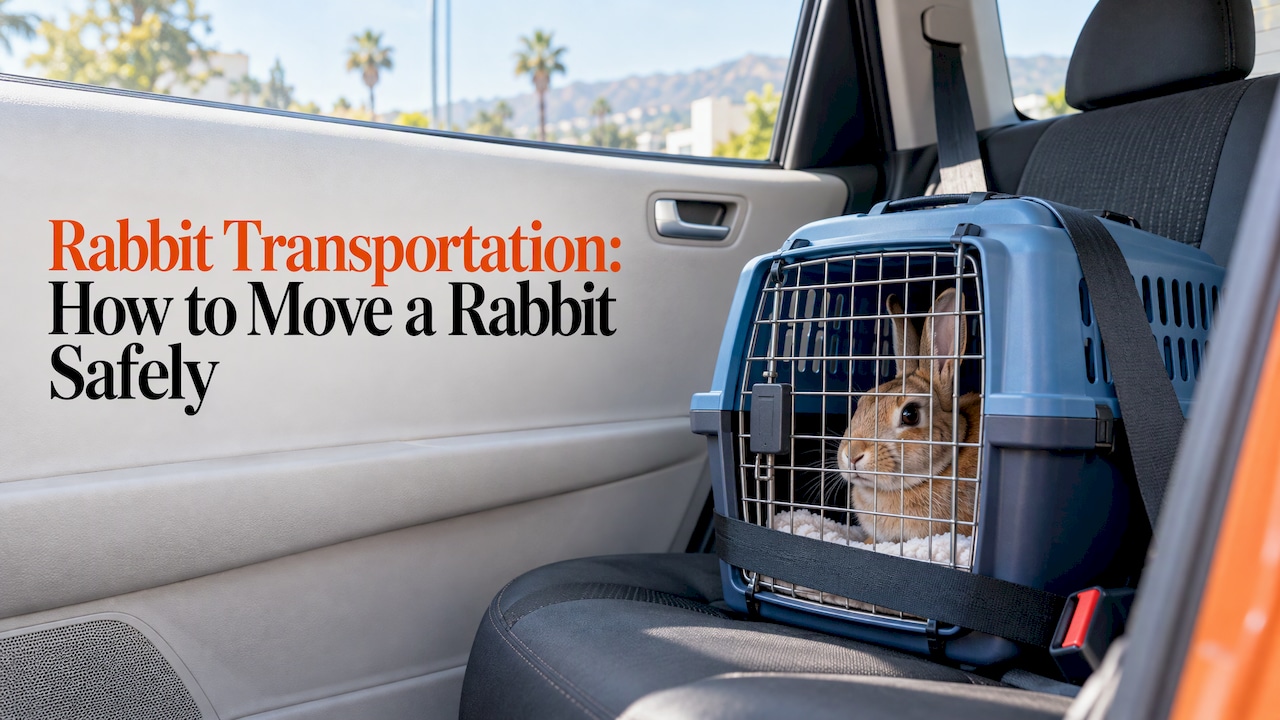
The safest way to transport a rabbit is in a hard-sided, chew-proof carrier that is seat-belted into a cool, quiet car, with hay and water inside and a smooth driver at the wheel. Rabbits are prey animals, they hide illness, and they overheat easily, so most travel problems come from heat, slippery floors, a carrier that slides, or a rabbit that stops eating. This guide covers the setup, the trip, what to watch afterward, how guinea pigs differ, and how to arrange a ride in Los Angeles when you would rather not drive yourself.
TL;DR
- Use a hard-plastic or wire carrier, 2 to 3 times the size of your rabbit, with a secure latch. Skip cardboard, nylon and cloth.
- Seat-belt the carrier or wedge it in a foot well so it cannot slide or tip. Never let a rabbit ride loose.
- Keep the car cool: heat stress starts above 86°F. Cool the car before loading and avoid the hottest hours.
- Offer hay, water and fresh greens, and watch eating and droppings afterward. No food or stool for 8 hours is a vet call.
- Need a driver? We run private, one-pet-owner rides across Los Angeles and Southern California for exotic animals, with updates during the trip.
Table of Contents
- Start before the trip: get your rabbit used to the carrier
- Choosing the right carrier
- What goes in the carrier
- Securing the carrier in the car
- Temperature: the part that goes wrong most often
- Driving and calming the trip
- Watching your rabbit during and after the trip
- Guinea pigs: what changes
- Paid rabbit transport: what to know
- Our perspective
- Book a private ride for your rabbit
- Travel-day checklist
- FAQ
- Sources
Start before the trip: get your rabbit used to the carrier
A carrier that appears only on the day of the vet visit becomes a symbol of the vet visit. PetMD’s veterinary guidance suggests leaving the carrier open at home where your pet is comfortable, putting treats inside so it becomes a positive place, and then taking practice rides in the car.
The Rabbit Welfare Association & Fund gives the same advice in a form that fits a vet visit: put the carrier in your rabbit’s area a few days ahead, with favorite food or treats inside. For longer journeys, the San Diego House Rabbit Society recommends short car rides that you gradually lengthen, which helps most on trips of many hours.
A simple three-step plan:
- Days before: leave the carrier open in the living area with hay and a few treats inside.
- A day or two before: close the door for a minute or two, then open it and reward. Add a short drive around the block.
- Travel day: feed your rabbit well ahead of departure, then offer favorite herbs or greens just before you leave and tuck some into the carrier. The Rabbit Welfare Association & Fund recommends this to reduce the chance of gut stasis.
If you share your home with a bonded pair and one needs the vet, the same organization advises taking both together. That limits stress and avoids one rabbit coming home smelling different to the other.
Choosing the right carrier
The carrier does most of the safety work. What the major rabbit organizations agree on:
- Hard-sided and chew-proof. PetMD calls appropriately sized hard-plastic carriers the safest option, and says cardboard boxes are not safe because rabbits and guinea pigs chew through them. MediRabbit adds that nylon and cloth carriers should be avoided for the same reason.
- Secure latch and sturdy handle. Rabbit.org recommends chew-proof materials such as wire and hard plastic, firm latches, and a handle that can bear your rabbit’s weight. It also suggests a metal-grate door where you can hang a water bottle, and warns against plastic doors a rabbit can chew.
- Dark and cave-like, with airflow. The same guide favors carriers that feel secure to a rabbit but have enough side holes for ventilation.
- Big enough to turn and stretch, not big enough to slide. House Rabbit Society recommends a hard-top carrier 2 to 3 times the size of the rabbit, and says a carrier of about 24 x 17 x 14.5 inches is comfortable for most rabbits.
Short trip or long trip?
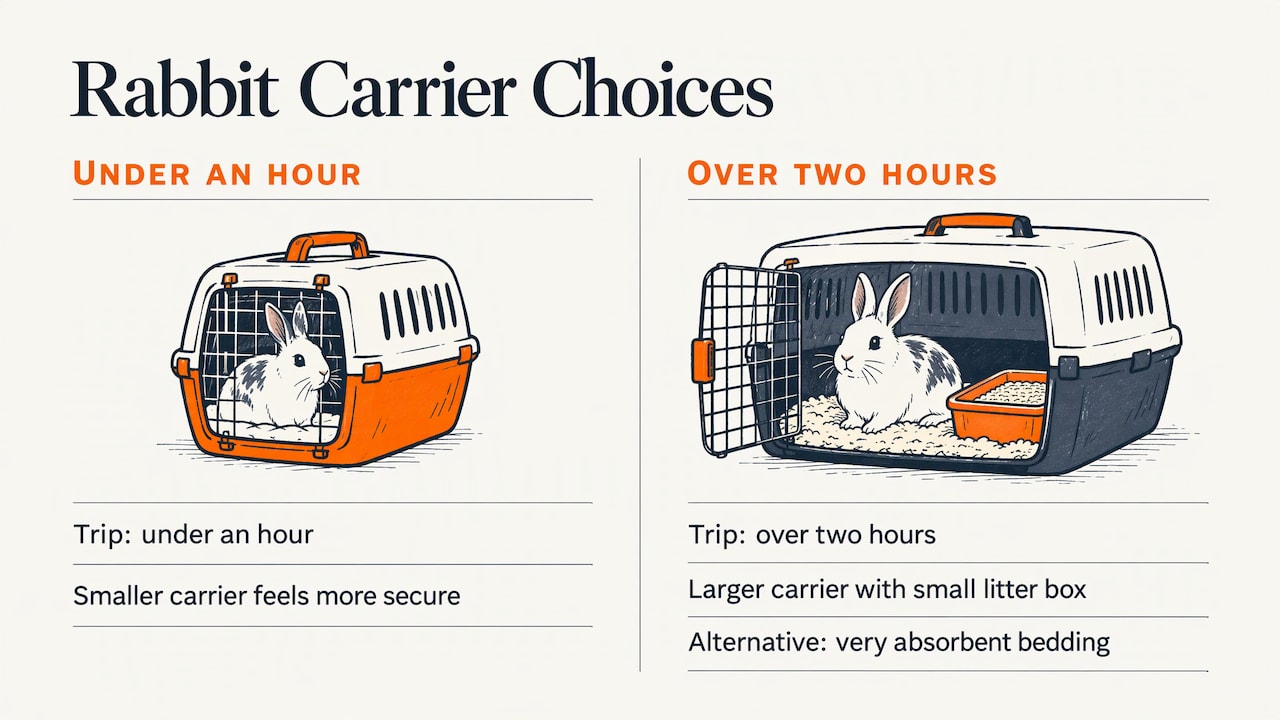
House Rabbit Network notes that on trips under an hour a smaller carrier often feels more secure to a rabbit, while trips over two hours call for a larger one with a small litter box or very absorbent bedding. A cross-town vet visit and a drive to San Diego are different jobs.
Line the floor
Plastic carrier floors are slippery. MediRabbit advises padding with a cushion, towels or a blanket so a sudden movement does not injure your rabbit. House Rabbit Society suggests a blanket topped with 2 to 3 disposable pee pads. The RSPCA suggests newspaper and hay so the floor is not slick, and a carrier that opens from both the top and the front, which makes lifting a nervous rabbit in and out easier.
Harnesses and leashes
House Rabbit Network does not recommend a leash in the car because it offers no protection. If you use a harness at all, it should go around the body, not the neck, and be snug enough to prevent escape. The carrier is still the main safety device.
What goes in the carrier
A rabbit that stops eating can slide into gut stasis, which is why the checklists all begin with food.
| Item | Why it is there |
|---|---|
| Hay | Constant chewing and fiber; the RSPCA wants hay in the carrier for eating |
| Water | Fresh water must stay available; non-spill travel bottles and bowls exist |
| Wet leafy greens | Extra hydration; House Rabbit Society suggests greens saturated in water |
| Favorite treats | Taking or refusing a treat is a stress gauge, according to the San Diego House Rabbit Society |
| Pellets | Part of the normal diet on longer trips |
| Blanket and pee pads | Traction and cleanup |
One detail from the Rabbit Welfare Association & Fund: avoid non-drip water bottles on longer journeys. A sudden stop could drive the spout into a rabbit’s eye. A bowl that does not spill, or a bottle with a proper drip design, is the safer pick.
If your rabbit is the kind to stop eating when stressed, the San Diego House Rabbit Society says to ask your vet in advance about a syringe-feeding product and keep it in your travel bag.
Securing the carrier in the car
PetMD says to belt the carrier to the seat if possible, or put it on the back floor where it cannot roll or topple. The RSPCA recommends a seat belt or a foot well behind a seat, with the side of the carrier facing the direction of travel.
A rabbit must never ride loose. MediRabbit warns that a free-roaming rabbit can startle the driver or be thrown through the windshield in a hard stop. Rabbit.org also states that rabbits must ride in the car with you, not in a trailer or anything towed, so you can monitor them and adjust the air conditioning or heat.
Temperature: the part that goes wrong most often
Rabbits cope with cold better than heat. PetSafe says rabbits are highly heat-sensitive: heat stress can begin above 86°F and heatstroke above 95°F. Its advice is to start the car and cool it before you load your pet, and to avoid the hottest part of the day.
In Los Angeles that matters most from late spring through October. A parked car at a vet lot can pass those numbers in minutes. Never leave a rabbit in a parked car, even briefly, and put the air conditioning on before you carry the carrier out.
The Rabbit Welfare Association & Fund, a UK charity, describes a well-ventilated vehicle at about 18 to 22°C (roughly 64 to 72°F) as ideal. It adds that stressed rabbits and those with respiratory disease should not be overheated, while a sick rabbit that cannot keep itself warm may need a snuggle pad.
Driving and calming the trip
Rabbit.org’s driving advice is simple: no sudden stops, jerky acceleration or abrupt lane changes, and keep the radio at a moderate volume. The Rabbit Welfare Association & Fund suggests gentle, low-level music.
Because rabbits are prey animals that frighten easily and need to hide, a cover over part of the carrier, such as a light towel that still lets air through, helps many rabbits settle. The same charity says some owners use calming products such as rabbit pheromone sprays, and that one of them tends to mask the smell of predators and vehicles. Ask your vet before trying any product.
For longer travel, the San Diego House Rabbit Society recommends:
- Talking to your vet about travel medications, gut stasis prevention and anything that eases travel stress.
- Keeping a list of rabbit-savvy exotic vets and emergency clinics along your route and at your destination.
Watching your rabbit during and after the trip
The RSPCA says to monitor eating, drinking and toileting on long journeys and contact a vet if any of them change. On a trip with stops, check the carrier at each one: is your rabbit alert, breathing easily, and taking a treat?
When to call:
- No eating and no droppings for more than 8 hours is abnormal, according to SpectrumCare, a veterinary practice, and can signal gut stasis or a blockage.
- Go to an emergency vet immediately for trouble breathing, collapse, seizures, heavy bleeding, inability to urinate, or stopping eating and passing stool.
- Same-day care is appropriate for reduced appetite, fewer droppings, head tilt, bloating or a sudden change in behavior. SpectrumCare notes that rabbits hide illness, and one that seems a little quiet in the morning can be critically ill by afternoon.
Call an exotic-savvy vet rather than waiting overnight. If you need to get a rabbit to an after-hours clinic and cannot drive, our emergency pet transport page explains how that works.
Guinea pigs: what changes
Most of the advice carries over. Guinea pigs need a hard-sided carrier, secure latches, bedding for traction, hay and water, and a belted or wedged position in the car. Differences worth knowing:
- Top-loading carriers and fleece. Guinea Pig Tube recommends a hard-sided, top-loading carrier lined with fleece and a little hay, sized so the pig or a bonded pair can turn around but not slide.
- Lower heat tolerance, in practice. The same source says guinea pigs can overheat dangerously above roughly 80°F, a few degrees below the 86°F heat-stress point PetSafe gives for rabbits. On warm days it suggests a cool pack wrapped in a towel, never ice directly on the pig, plus air conditioning and shade.
- Smaller space needs. Research-animal transport guidelines from the National Academies Press set minimum enclosure floor space per guinea pig by weight, from about 194 cm² for animals under 350 g, and a minimum interior height of 15.2 cm under 500 g. Those are minimums for laboratory shipping. A pet carrier should be roomier.
Heatstroke in a guinea pig is an emergency. Go straight to a vet.
Paid rabbit transport: what to know
If you cannot drive, a private pet ride is a legitimate option. A few facts help you judge any service.
In the US, the Animal Welfare Act covers businesses that take custody of regulated animals and transport them for hire. USDA APHIS lists the transport standards for rabbits in 9 CFR Subpart C, sections 3.60 to 3.66, and for guinea pigs and hamsters in Subpart B, sections 3.35 to 3.41.
The National Academies Press guidelines say that for trips over 6 hours, guinea pigs, hamsters and rabbits need food and water in the enclosure, and that the enclosure must hold them securely, let each animal turn around normally while standing, and have no interior protrusions that could injure them.
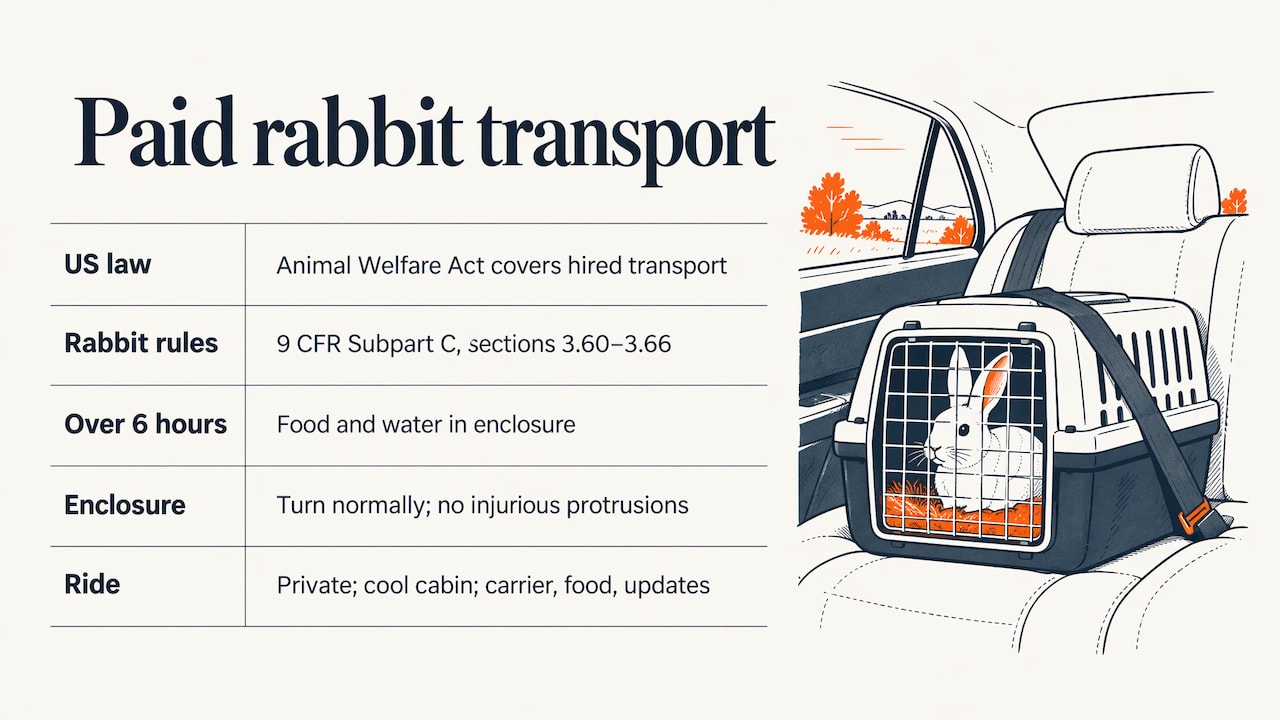
In practical terms, look for a ride that is private (not shared with other animals), a driver who will keep the cabin cool, a plan for your rabbit’s own carrier and food, and a way to be kept informed. Our guide to how a pet taxi works walks through booking and the day of the ride.
Our perspective
Rabbits are not small dogs, and we do not treat them like it. A rabbit does not tell you it is stressed, so everything about the ride has to be calm before anything goes wrong: a steady driver, a cool cabin, no sudden stops, and nobody else’s animals in the vehicle.
That is why every ride we run is private and handled by the same experienced driver, and why pets are never handed off to strangers or put in shared rides. Our driver specializes in anxious and special-needs pets, and we send updates to owners during transit so you are not left wondering how the trip is going.
Many of our rabbit and exotic-pet calls are vet visits, and some come after hours. We are available for after-hours emergencies because a rabbit that has stopped eating cannot wait for Monday. If your rabbit will be home alone while you travel, our in-home drop-in visits keep it in familiar surroundings, with feeding, condition checks, medication and photo updates.
Bring your own carrier set up the way your vet recommends, with hay and water inside. We will take it from there.
Brian
Book a private ride for your rabbit
We offer private pet transportation for dogs, cats and exotic animals across Los Angeles and Southern California, for vet visits, grooming, airport transfers and longer trips. Local rides start from $100 per ride, with 10 miles included and $3.50 per additional mile after that. See our pet transportation services or request a quote on our home page.

A few things shape the final quote:
- Distance. Longer routes are priced per trip: LA to Santa Barbara is $375, LA to Palm Springs $450, LA to San Diego $500, LA to San Francisco $1050 and LA to Sacramento $1200.
- Timing. Rush hour (AM/PM) adds $25, and after-hours or emergency rides add $40.
- Waiting. If the driver waits at the clinic, wait time is $65 per hour.
- More than one pet. An additional pet starts from $15. A bonded pair often travels better together, and you can tell us when you request your quote.
If you need someone to feed or check on your rabbit at home while you are away, see our drop-in pet sitting, at $50 to $75 per visit. Medication administration adds $10.
Travel-day checklist
- Rabbit has eaten well and has had a chance to toilet.
- Carrier is hard-sided, latched, lined with a blanket and pee pads, with hay and a water source inside.
- Car is cooled before loading; the cabin is aiming for the mild range, never hot.
- Carrier is belted in or wedged in a foot well, with the side facing the direction of travel.
- Treats and wet greens are within reach, plus your vet’s number and the nearest exotic emergency clinic.
- After arrival, watch eating and droppings for the rest of the day.
For trips to LAX or other airports, see our Los Angeles airport transport page. For a general view of how we handle rides across the region, our Los Angeles car transport page has the detail.
FAQ
Can I transport a rabbit in a cardboard box?
No. PetMD says rabbits and guinea pigs routinely chew cardboard and can gnaw their way out before you arrive. Use a hard-plastic or wire carrier with a secure latch, lined with a towel or blanket for traction.
How long can a rabbit go without eating on a trip?
Not long. A rabbit that goes more than 8 hours without eating or producing stool needs veterinary attention, according to SpectrumCare, because it may be developing gut stasis or a blockage. Feed your rabbit well before departure, keep hay in the carrier, and call a rabbit-savvy vet if eating or droppings change.
What temperature is safe for a rabbit in the car?
Aim for a mild cabin. The Rabbit Welfare Association & Fund considers roughly 18 to 22°C (64 to 72°F) ideal, and PetSafe says heat stress can start above 86°F. Cool the car before loading, avoid the hottest hours, and never leave a rabbit in a parked car.
Can a rabbit ride on my lap or in a harness?
No. Rabbit.org and MediRabbit both point to a secured carrier as the safe option. House Rabbit Network says leashes offer no protection in a car, and a loose rabbit can startle a driver or be thrown in a sudden stop.
Do you transport rabbits and other exotic pets in Los Angeles?
Yes. We provide private pet rides across Los Angeles and Southern California for dogs, cats and exotic animals, including after-hours emergency transport. Request a quote on our services page with your rabbit’s details, pickup and destination.
Sources
- How to Safely Transport Your Small Animal to the Vet, PetMD
- Moving with Rabbits, San Diego House Rabbit Society
- How to transport your rabbits safely, Rabbit Welfare Association & Fund
- Traveling With a Rabbit: Your Complete Guide, Rabbit.org
- Travel and Rabbits, House Rabbit Society
- Transporting your rabbits, RSPCA
- Choosing a Carrier for Transport, House Rabbit Network
- Carrier, MediRabbit
- Pet Travel Safety Tips, PetSafe
- When to Go to the Emergency Vet: Rabbit, SpectrumCare
- Transporting Animals in Commerce, USDA APHIS
- Guidelines for the Humane Transportation of Research Animals, National Academies Press
- Best Guinea Pig Carrier, Guinea Pig Tube