
Most cats dread travel because it is rare, unpredictable and usually ends somewhere unpleasant. The fix is a mix of slow carrier training, a smooth and secure ride, and, for cats who still struggle, a conversation with your vet. For trips you cannot train for, such as an urgent vet visit or an airport run, a quiet private ride with one steady driver keeps the experience as short and calm as possible. That is what we do at Pets Go Taxi for cats across Los Angeles and Southern California.
TL;DR
- Cats learn that carriers and cars lead to scary places, so anxiety builds with each stressful trip. Short, pleasant practice trips reverse it.
- Never force a cat into a carrier. Let the cat choose to enter, with bedding, treats and a familiar scent.
- Secure the carrier on the vehicle floor, drive smoothly and keep the cat inside it for the whole ride.
- Pheromone products, anti-nausea drugs and anti-anxiety medication are different tools. Your veterinarian decides which, if any, fits your cat.
- For emergencies, after-hours trips and airport transfers, a private ride with no shared vehicle keeps the cat’s day simple.
Table of Contents
- Why cats get anxious when they travel
- Signs your cat is anxious or carsick
- Step 1: Make the carrier part of the furniture
- Step 2: Add familiar scent and cover
- Step 3: Teach the car in stages
- Step 4: Run the ride itself
- Calming products and medication: what to ask your vet
- When to call the veterinarian
- When a private ride is the calmer option
- Book a calm ride for your cat
- Our view: calm is built, then protected
- FAQ
- Sources
Why cats get anxious when they travel
Dogs often learn that the car means the park. Cats rarely get that lesson. VCA Animal Hospitals explains that cats travel so seldom, and the trip usually ends at the vet, that the carrier and the car become a warning signal. It suggests aiming for at least 10 positive car trips to pleasant places for every trip to a slightly scary destination.
The same page says that many cats are only in a car once or twice a year, which is exactly the pattern that keeps fear alive. VCA also notes that most motion sickness in cats comes from travel stress and anxiety, particularly in cats that associate the car with the stressful event that follows.
There is a second layer: the unfamiliar. A cat is a territorial animal, and a moving box full of strange sounds, vibrations and smells takes away every cue that says “home.” Understanding this changes the goal. You are not trying to make the cat tolerate a bad experience. You are trying to remove as many unfamiliar elements as you can and replace them with predictable, familiar ones.
Signs your cat is anxious or carsick
Cats hide discomfort, so the early signs are easy to miss. Zoetis lists these signs of acute travel anxiety in cats:
- Restlessness
- Continuous licking or grooming
- Tail flicking or flattened ears
- Freezing or crouching
- Intense breathing or panting
- Urinating or defecating
- Dilated pupils
It warns that unmanaged signs can get worse with each experience. VCA adds signs that overlap with motion sickness: excessive vocalizing, pacing, lip licking, drooling, lethargy and vomiting.
A quiet cat is not always a calm cat. A cat frozen at the back of the carrier with wide pupils is as stressed as one that yowls. Learn what your cat looks like at rest, then compare.
Step 1: Make the carrier part of the furniture
Most travel problems start at the front door, with a cat being chased and stuffed into a carrier. The AAHA guidance on helping cats cope with vet visits is blunt: never force a cat into the carrier, because doing it even once can undo weeks or months of careful training.
Choose the right carrier. AAHA recommends a carrier that lets the cat stand, turn around, sit and lie down comfortably. It should be well ventilated, easy to clean and have a front door so the cat can walk in voluntarily. The FelineVMA’s carrier guide for caregivers advises avoiding soft carriers that collapse, backpack carriers and carriers without removable tops.
Leave it out all the time. VCA’s crate and travel training tips start with leaving the carrier in a quiet part of the main living area, made inviting with favorite bedding and food.
Build up in small steps. Based on the AAHA and VCA advice:
- Put treats near the carrier, then at the entrance, then a little further inside.
- Once the cat enters happily, close the door for a few seconds, then open it and reward.
- Lengthen the time slowly, then carry the carrier around the house.
- Only then introduce the car.
Where it goes wrong: moving too fast. If your cat shows visible anxiety, stop and try again another day. Training is measured in weeks, not an afternoon.
Step 2: Add familiar scent and cover
AAHA suggests warm, soft bedding and a spray of Feliway, a synthetic feline pheromone, on the bedding and carrier interior, letting the alcohol scent dissipate before the cat goes in. The AAFP and ISFM Feline-Friendly Handling Guidelines recommend spraying at least 30 minutes before transport and placing a towel over the carrier to reduce visual stimulation. The FelineVMA brochure gives a shorter window for a pheromone-sprayed towel: 15 minutes before the cat enters. Follow the directions on your product.
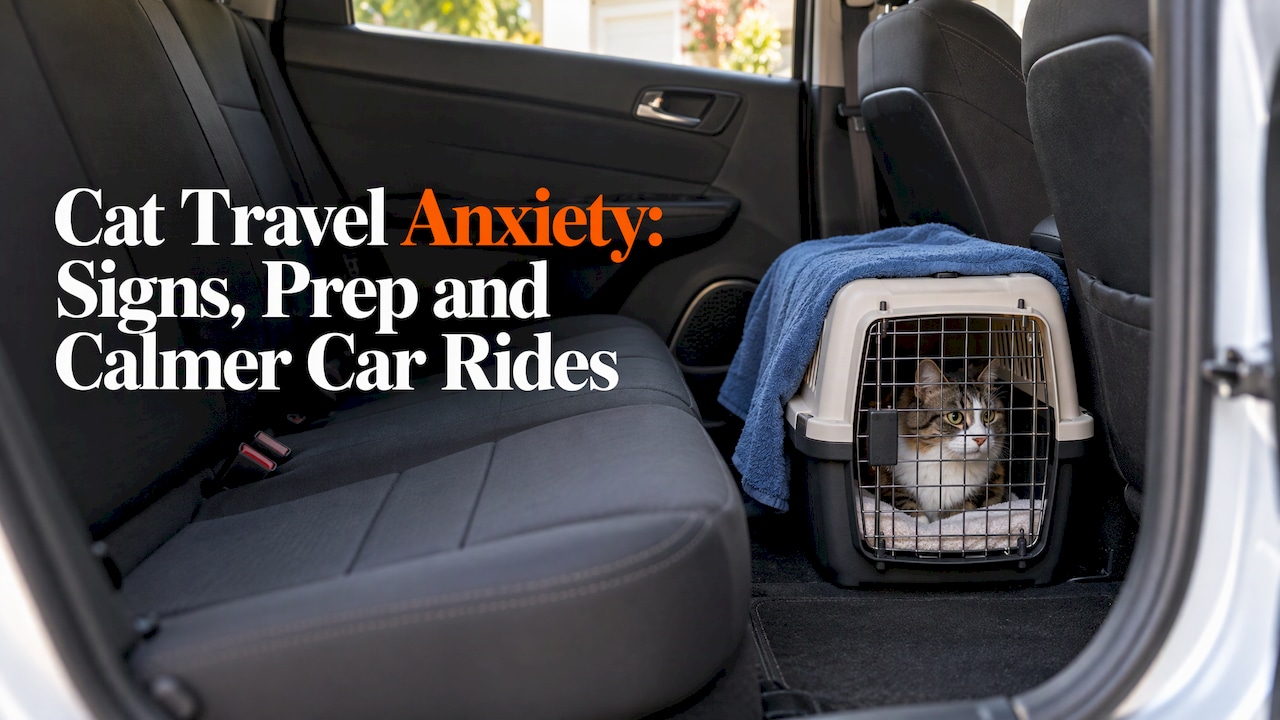
A T-shirt or blanket that smells like you also helps. AAHA recommends lining the carrier with a familiar-scent blanket or T-shirt. A hiding place matters too: the FelineVMA’s 2025 position statement on transporting cats in vehicles recommends giving cats a hiding opportunity, such as a towel or blanket over the carrier.
Step 3: Teach the car in stages
VCA describes a stepwise plan in its motion sickness article:
- Put the carrier in the parked car with the motor running, then reward with food inside the carrier.
- The next day, back out of the driveway.
- Then drive around the block.
- Build gradually to rides of 20 to 30 minutes.
Add the destination ratio from earlier: make most of those drives end somewhere pleasant, and keep the vet as the occasional exception. VCA recommends weekly drives to maintain comfort.
Step 4: Run the ride itself
On the day of travel, the details matter.
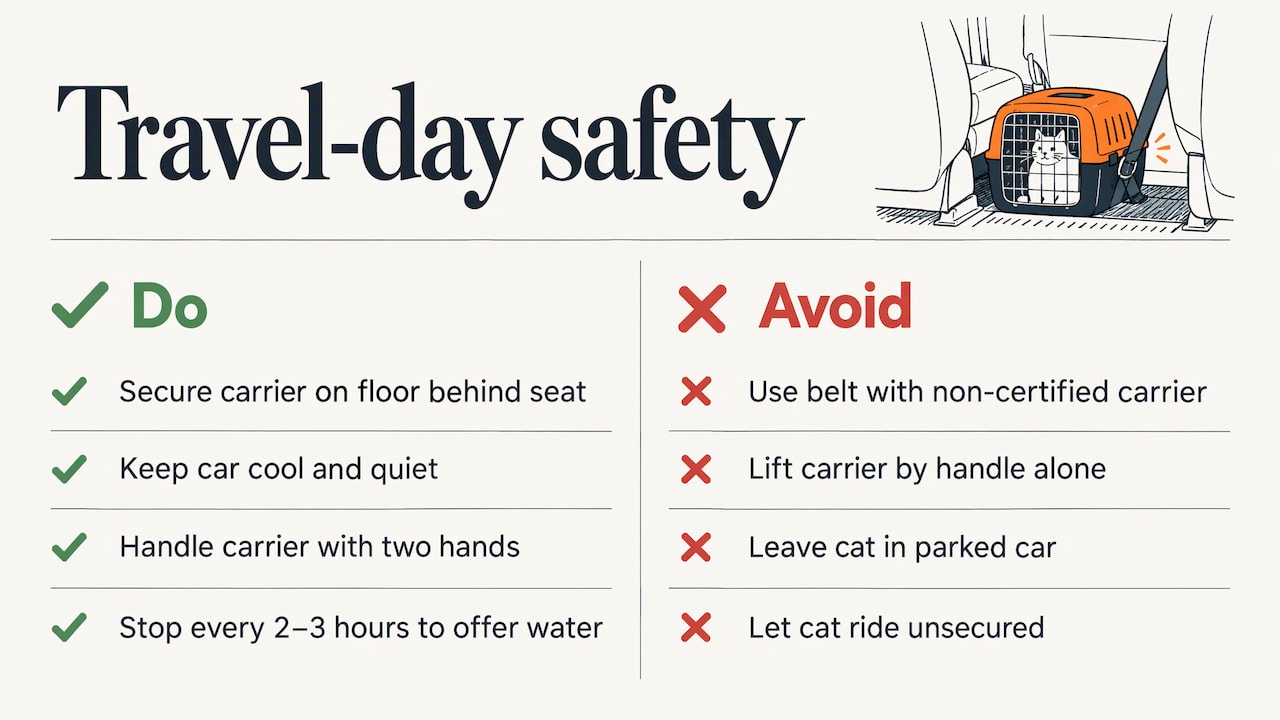
Position and handling. The FelineVMA position statement recommends securing the carrier on the vehicle floor behind the driver or passenger seat. Use a seat belt only with a crash-test-certified carrier, since belting a non-certified carrier may crush it. Support the carrier with two hands under the bottom, never by the handle alone, and keep it level, per the carrier brochure.
Food and water. VCA’s road-trip guidance says to withhold breakfast on travel day to minimize nausea and line the carrier with an absorbent potty pad. Its motion sickness article goes further and mentions withholding food for up to 8 hours before travel, with fresh water available. Ask your vet what is right for your cat, especially for a senior cat or one with a medical condition.
Environment. Keep the car cool and quiet. VCA mentions soft classical music, a travel-only toy and a scent-bearing T-shirt.
Stay calm yourself. The AAFP and ISFM guidelines stress that your anxiety affects your cat. Move at the cat’s pace, use rewards and keep your voice level.
Keep the cat in the carrier. AAHA says to keep the cat secured throughout the ride even if it cries. If a cat must be out, VCA says to use a harness and leash. Never leave a cat alone in a parked car: VCA warns that interior temperatures can rise to dangerous levels quickly and cause heat stroke. In Southern California that is not a theoretical risk.
Long drives. For trips over six to eight hours VCA says to have litter available. Lane Veterinary advises stopping every two to three hours on long rides to offer water.
Calming products and medication: what to ask your vet
This is a veterinary decision, so use it to prepare for the appointment, not to self-treat.
Pheromones and calming products. VCA says Feliway, products with casein protein derivative or L-theanine, and some natural remedies can help. It also says to consult a veterinarian before starting any medication or supplement, including non-prescription ones.
Anti-nausea medication. Drugs such as maropitant can prevent vomiting in a stressed pet, but VCA notes they help motion sickness, not anxiety.
Anti-anxiety medication. For very anxious cats, prescription options can relax them and may be sedating. Clinicians’ Brief reports that gabapentin and trazodone are commonly used off-label for anxious cats, while pregabalin has an FDA-approved indication. Today’s Veterinary Practice describes an FDA-approved pregabalin oral solution given about 90 minutes before the stressful event, and notes it is a Schedule V controlled substance. The label advises caution in cats with cardiac disease, hypertension or kidney disease, which is why your vet needs your cat’s full health picture first.
Questions to bring to your vet:
- Is my cat healthy enough for a calming medication, given age and conditions?
- Should I give a trial dose at home before the real trip? Lane Veterinary recommends testing any sedative well ahead of the trip to watch for side effects.
- Are there non-drug options to try first? Lane Veterinary notes some cats respond well to alternative calming methods.
- What should I never give? Lane Veterinary advises never using human medications without veterinary approval.
Tell your vet and the clinic in advance if your cat gets easily upset, as the AAFP and ISFM guidelines suggest. Many clinics can move a nervous cat straight into an exam room.
When to call the veterinarian
Some signs call for a professional, not another tip. Lane Veterinary lists prolonged excessive vocalization, panting or drooling, aggressive or frantic behavior in the carrier, and vomiting as reasons to consult your vet before deciding on sedation. VCA says prolonged vocalization, escape attempts or salivation during crate training warrant a conversation with your vet.
Panting deserves special attention. Cats.com notes that stress-related panting should settle once the cat is no longer stressed. Panting that does not subside, or comes with other abnormal signs, needs veterinary attention, and a cat struggling to breathe is an emergency. Call your vet or the emergency hospital as you leave home.
When a private ride is the calmer option
Training works when you have weeks. Many cat trips arrive with no warning: a limp that cannot wait, a late-night emergency, a flight in a few days, a vet appointment you cannot leave work for. In those cases the aim is to shorten and simplify the trip.
This is where the way a cat is transported matters. At Pets Go Taxi every ride is private. The same experienced driver handles it, and pets are never handed to strangers or placed in shared rides. Owners get updates during the trip. We take cats, dogs and exotic animals to vet visits, grooming, airport transfers and emergencies, including after hours. You can read more on our page about pet transport in Los Angeles for cats, or see how a pet taxi works if you have never booked one.
A private ride supports everything above. Your cat stays in its own carrier with its own blanket and the scent you prepared, and does not share space with other animals. You can prepare the carrier calmly at home instead of managing a car, traffic and a cat at once.
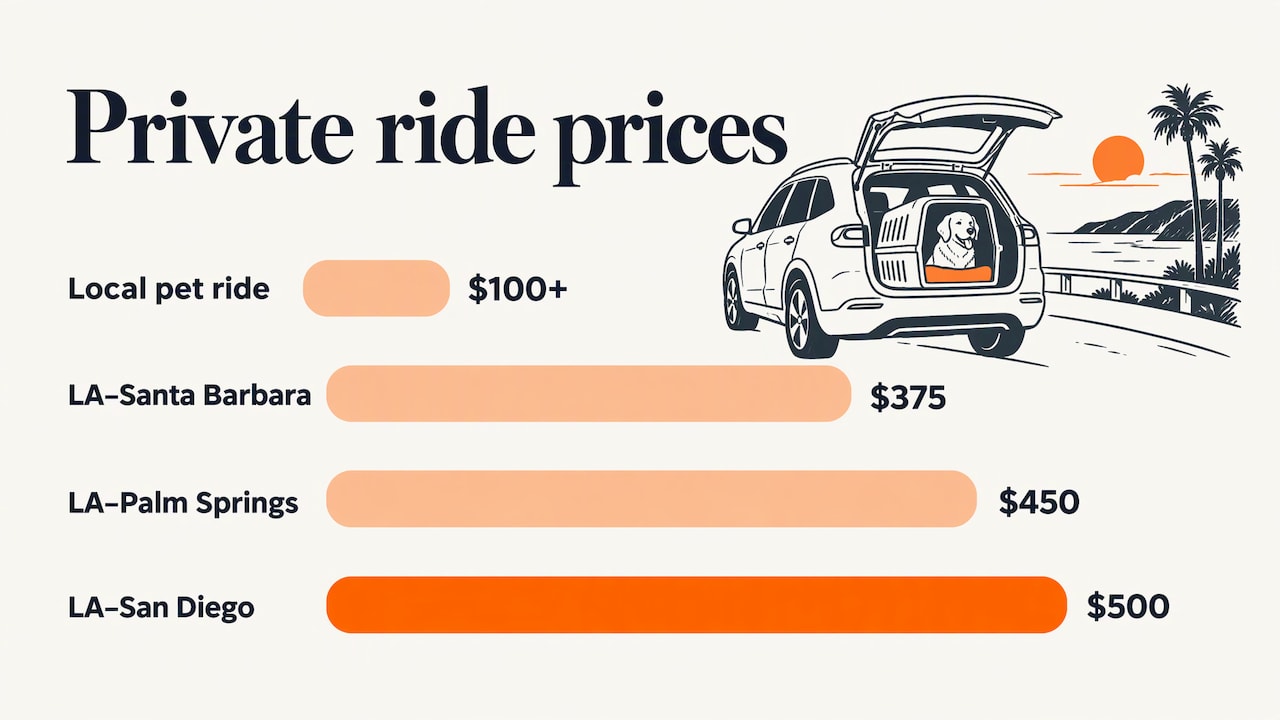
What it costs is published on our site. Local pet rides start from $100 per ride. Extras are a $25 rush hour fee (AM/PM), a $40 after-hours or emergency fee, $3.50 per mile beyond 10 miles, and driver wait time at $65 per hour, which is useful to know if you want your cat taken to an appointment and brought home afterward. Longer routes are priced per ride, for example LA to Santa Barbara at $375, LA to Palm Springs at $450 and LA to San Diego at $500. Airport transfers and emergency transport have no published price, so we quote them for your trip.
Going away yourself? Many cats do better staying home in familiar surroundings. See our guide to cat care during vacation, and our drop-in pet sitting runs $50 to $75 per visit, with medication administration for $10 added if your cat needs it.
Book a calm ride for your cat
If your cat has a vet appointment, a flight or an urgent need and you want a quiet, private trip, tell us about your cat, the pickup and the destination, and we will quote the ride. Our pet transportation services page lists local rides, airport transfers and emergency transport. If the situation is urgent, start with our page on emergency pet transport.

Want to compare providers before choosing? Our guide on how to choose a safe pet taxi service walks through the questions to ask.
Our view: calm is built, then protected
We handle a lot of nervous animals, and the pattern is the one the veterinary guidance describes: the cat that is rushed, chased or handed around has the worst trip. A cat’s fear grows with each bad experience, so our job is to make this one uneventful.
That is why every ride we do is private and handled by the same driver, with no shared vehicles and no handoffs to strangers. We send updates during the trip, so you are not guessing how your cat is doing. A calm owner helps a calm cat.
Do the training at home when you can: the carrier out in the living room, the slow steps, the short pleasant drives. When you cannot, because it is an emergency, after hours or a flight, we are the steady, quiet ride in between. And if your vet has recommended a calming plan, we work around it.
Brian
FAQ
How long does it take a cat to calm down after a car ride?
It varies by cat. Stress-related panting should settle once the cat is no longer stressed, according to Cats.com, and a cat that keeps panting or shows other abnormal signs needs a vet. Give your cat a quiet room, its own litter box and water, and let it come out of the carrier on its own.
Should I sedate my cat for travel?
That is a decision for your veterinarian, who will assess your cat’s health, temperament and the trip. Lane Veterinary says some cats respond well to other calming methods and that any sedative should be tested well before the trip. Never give human medication without veterinary approval.
Do pheromone sprays work for cat travel anxiety?
VCA lists Feliway-type pheromones among the products that can help, and AAHA and the FelineVMA both include pheromone use in their carrier advice. Spray the carrier or bedding as the product directs and let the alcohol scent dissipate before the cat goes in.
Can a cat travel in the car without a carrier?
No. AAHA advises keeping the cat secured in the carrier throughout the ride, and VCA says that if a cat must be out it should be on a harness and leash. A loose cat is a danger to itself and to the driver.
Can you book a ride for a cat in Los Angeles?
Yes. We provide private rides for cats to vet visits, grooming, airport transfers and after-hours emergencies across Los Angeles and Southern California. Local rides start from $100.
Sources
- Motion Sickness in Cats, VCA Animal Hospitals
- Cat Behavior and Training: Crate Training and Travel, VCA Animal Hospitals
- Crate and travel training tips for cat owners, VCA
- Road Trips and Car Travel With Your Cat, VCA Animal Hospitals
- Bonqat for Pet Owners, Zoetis Petcare
- Helping your cat cope with veterinary visits, AAHA
- How to Reduce Cat Stress at the Vet, AAHA
- AAFP and ISFM Feline-Friendly Handling Guidelines, PMC
- FelineVMA 2025 position statement on transportation of cats in motor vehicles, PMC
- A Cat Carrier Guide for Caregivers, FelineVMA
- What’s New With Feline-Friendly Previsit Pharmaceuticals, Today’s Veterinary Practice
- Anxiety Disorders in Dogs and Cats: Treatment Options, Clinician’s Brief
- Should You Sedate Your Cat for Travel? Lane Veterinary
- Cat Panting: Causes, Symptoms, and Treatment, Cats.com