
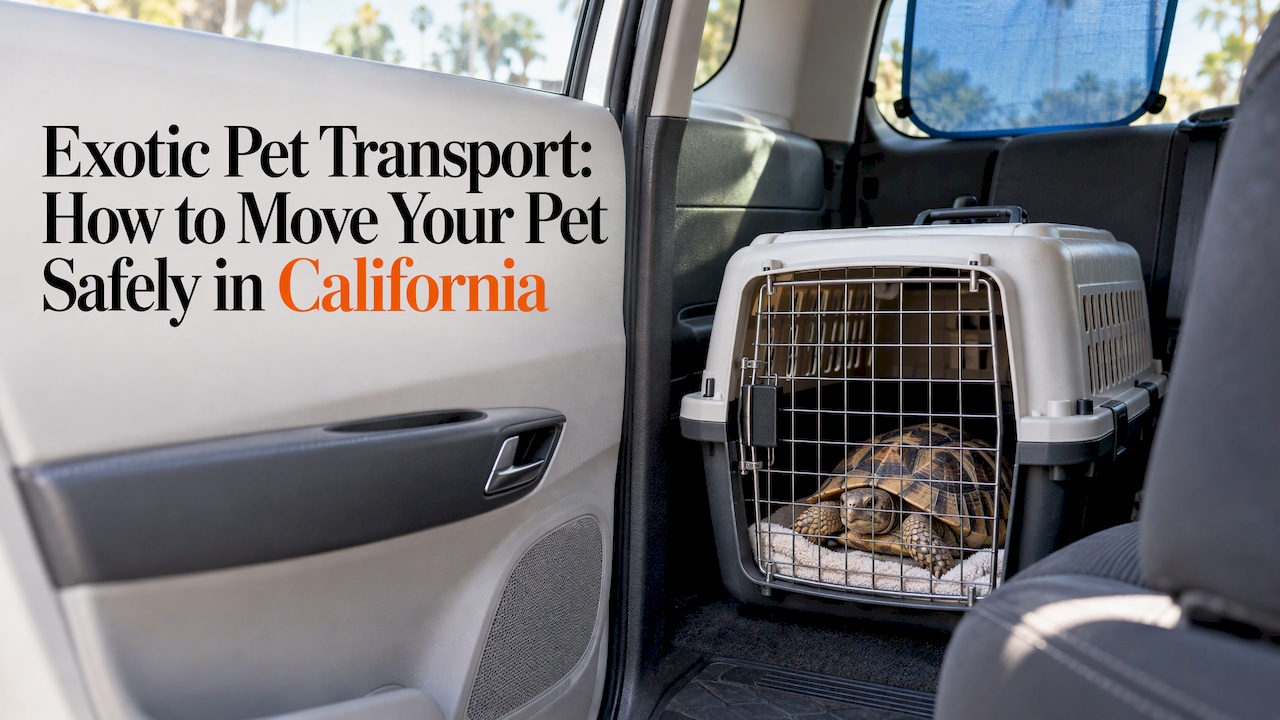
The safest way to move most exotic pets is a private ground ride: one driver, one climate-controlled space and no handoffs. Airlines restrict many species, and shared transport multiplies stress. At Pets Go Taxi, every ride is private and handled by the same experienced driver, with updates sent to you in transit. Below is what you need to prepare, what the rules say and what a ride costs.
TL;DR
- Most major airlines accept only a short list of small pets, such as household birds, guinea pigs, rabbits and hamsters, and set strict temperature limits. Reptiles and many other species usually travel best by ground.
- Keep the carrier secure, ventilated and at a stable temperature, and plan your stops before you leave.
- Interstate trips usually require a health certificate and sometimes permits. Check the rules for your destination and for any state you pass through.
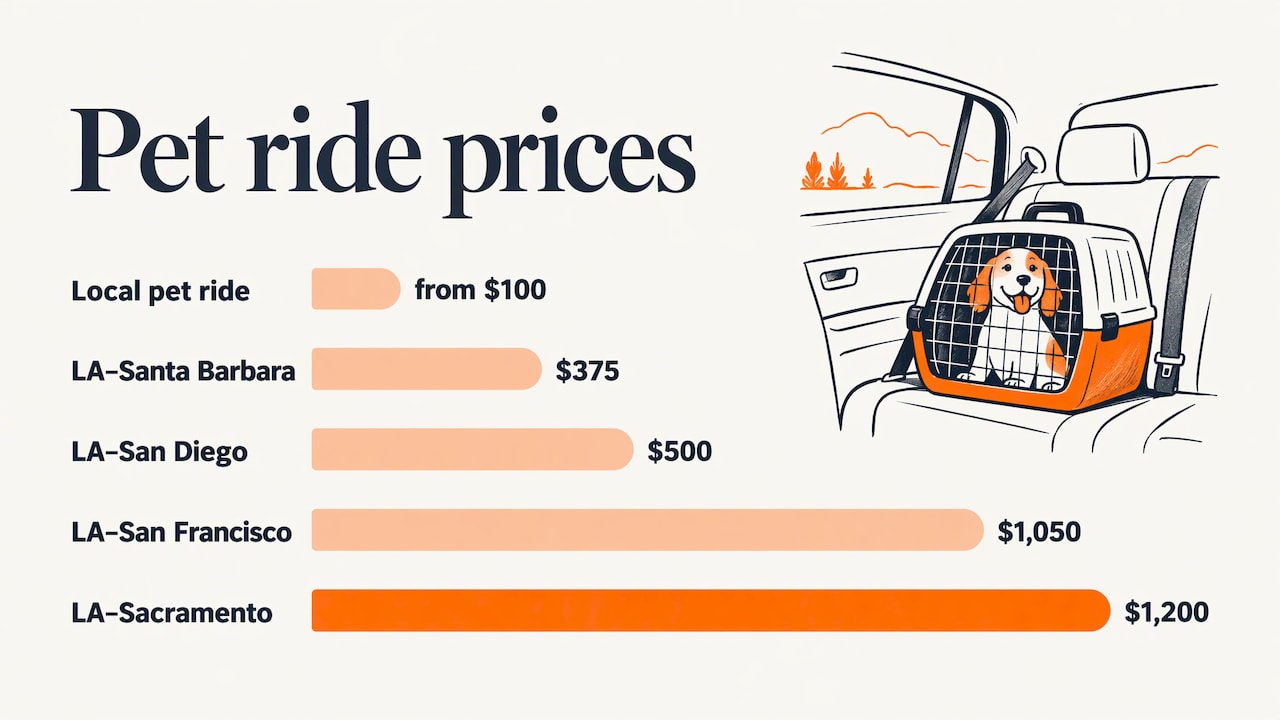
- Our local rides start at $100, and city-to-city runs are priced per route, for example $375 from LA to Santa Barbara and $500 from LA to San Diego.
Table of Contents
- What counts as an exotic pet for transport
- Why ground transport usually wins
- Preparing your pet and carrier
- Rules and paperwork
- Planning the route and the stops
- What exotic pet transport costs with us
- Airport transfers and emergencies
- When you are away: in-home care
- Our perspective
- Book a private ride
- FAQ
- Sources
What counts as an exotic pet for transport
There is no single legal list of exotic pets. In practice the term covers birds, reptiles, small mammals such as rabbits, ferrets, hedgehogs and sugar gliders, amphibians and fish. What matters for travel is that each group has different needs for temperature, handling and paperwork.
One definition matters for international or regulated travel. The USDA’s Animal and Plant Health Inspection Service (APHIS) describes a pet as a privately owned companion animal not intended for research or resale. It also says chickens, ducks, geese, pigeons, quail, turkeys and similar birds are regulated as poultry, not pets. If you are crossing a border, APHIS tells you to contact a USDA-accredited veterinarian for destination requirements and a USDA-endorsed health certificate.
For trips inside California, start with a simpler question: can your animal handle the time in a carrier, the temperature and the motion? Your exotic vet can answer that for your individual animal, and the American Veterinary Medical Association asks that transport plans assess fitness for travel and weigh species, age, climate and transit time, then build in rest, feeding and watering.
Why ground transport usually wins
Flying an exotic animal is the hardest option. Airlines publish their own species lists, and those lists are short.
- Delta accepts household birds, guinea pigs, rabbits and hamsters as checked baggage on domestic flights in IATA-compliant crates. It warns that pet and tropical birds are at risk when any temperature on the itinerary drops below 50°F.
- Delta’s cargo guide asks for health certificates signed within 10 days of travel, ground temperatures between 20°F and 80°F at origin, transfer and destination, and permits where they apply. It also limits the airline’s liability for illness, injury or death from natural causes or inadequate packaging.
- A veterinary directory’s 2026 guide reports that several large US carriers refuse exotic pets in the cabin and most refuse them in cargo.
That leaves a car. Driving yourself works for some owners, but it takes a whole day or more, and you cannot watch the carrier while you drive. A private pet ride puts a second set of experienced eyes on your animal.
Preparing your pet and carrier
The animal’s comfort in the first 24 hours depends mostly on the carrier and the temperature. Here is the routine.
- Choose a hard-sided carrier with secure ventilation. It should have a locking latch and absorbent lining. The animal should be able to turn and settle but not be thrown around.
- Give the animal somewhere to hide. The veterinary guide recommends a snug-fitting hide for reptiles and a partially covered carrier for birds, which lowers visual stress.
- Control the temperature. The same guide cites reptile transport guidance that keeps carriers between 75°F and 85°F for the whole trip, using heat packs in winter and cooling packs in summer. Never leave a carrier in a parked car, and keep it out of direct sun and vents.
- Time meals. The guide suggests skipping meals 12 to 24 hours before departure, with water offered at every stop. Confirm timing with your exotic vet, because small mammals and birds with fast metabolisms often have different needs.
- Label and document. Put your phone number and the animal’s species on the carrier, and carry copies of any health certificate, permit and ID in one folder.
- Ask your vet about fitness. A pet that is ill, molting, pregnant or very young may need to wait. A vet visit before the trip is also the time to ask about the specific species’ limits.
When you book with us, tell us the species, size and temperature needs up front so the ride fits your pet. Our service is built around calm, stress-free journeys, and every ride is tailored to the individual animal, from secure carriers for small animals to roomy space for larger ones.
Rules and paperwork
This is where owners get surprised, because the rules depend on species and on every state you touch.
Who regulates what
Under the Animal Welfare Act, APHIS regulates airlines, motor carriers and other businesses that take custody of animals and move them for hire. Pets that stay in their owner’s custody, such as a pet in the cabin or riding in a hired taxi, are not covered by the Act. Other federal or state requirements may still apply.
Health certificates and permits
A veterinary guide reports that almost every state requires a Certificate of Veterinary Inspection, a health certificate issued within 30 days of travel by a USDA-accredited veterinarian. It also says many states require permits for venomous reptiles, large cats, primates and certain parrots, and that USDA permits cover marine mammals, primates and some raptors.
The same page notes that many parrots need CITES paperwork, which is the international treaty permit for protected species, and that rabbit movement can be restricted because of disease control. See our guides to parrot transportation and rabbit transportation for species-specific preparation.
California is stricter than many states
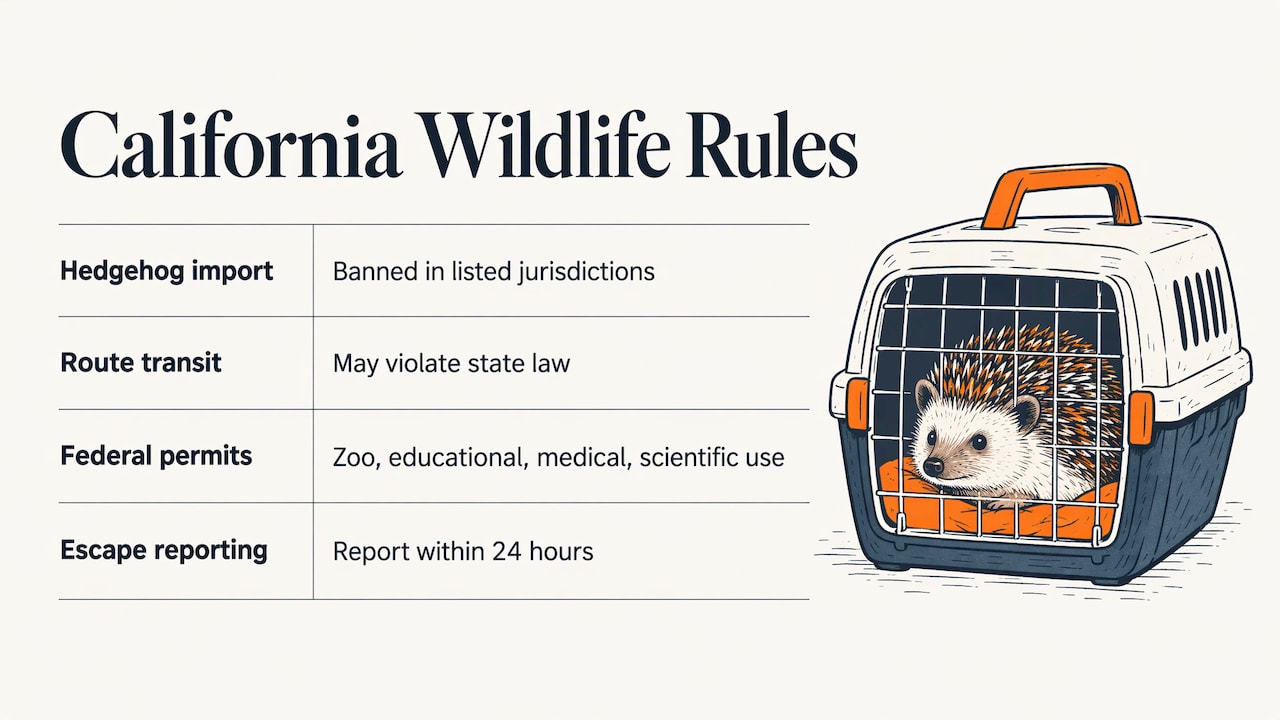
Hedgehogs are a clear example. APHIS lists California among the states, along with Georgia, Hawaii, Pennsylvania, Washington DC and the five NYC boroughs, that prohibit importing pet hedgehogs. Species rules change, so confirm your animal’s legal status with the state wildlife agency and your vet before you plan any move into or through California.
The same veterinary guide adds that passing through a state where a species is illegal can technically violate that state’s law, so map your route around restricted states.
For wildlife classed as injurious, federal rules go further: the Fish and Wildlife Service can issue permits only for purposes such as zoological, educational, medical or scientific use, and conditions include reporting an escape within 24 hours. If your animal falls in a regulated category, talk to your vet and the relevant agency first.
Planning the route and the stops
A long drive needs a schedule built for the animal, not the driver. The AVMA’s guidance asks planners to think about rest, feeding and watering by species, climate and transit time. That means shorter legs in heat, no unplanned waits and a place to stop where the carrier can stay in the shade or indoors.
If you are driving a long route yourself, planning pet-friendly stops and stays before you leave removes the guesswork at the end of a long day. With a private driver you only choose the pickup and drop-off, and the driver handles the timing.
What exotic pet transport costs with us
Prices below are as published on our site. Final quotes depend on distance, pet size, timing and add-ons.
| Ride | Price |
|---|---|
| Local pet ride | from $100 |
| LA to Santa Barbara | $375 |
| LA to Palm Springs | $450 |
| LA to San Diego | $500 |
| LA to San Francisco | $1050 |
| LA to Sacramento | $1200 |
Fees that can apply on top:
- Additional miles beyond 10: $3.50 per mile
- Rush hour (AM/PM): $25
- Driver wait time: $65 per hour
- After hours or emergency: $40
- Large breed (50+ lbs): $25
Airport transfers and emergency transport are quoted individually. For a sense of how a route price breaks down, see our page on Los Angeles to Palm Springs costs.
For comparison, one 2026 relocation guide puts professional coast-to-coast ground transport anywhere between several hundred and a few thousand dollars with several days in transit. A private in-state ride is a very different job, with one driver and a few hours on the road.
Airport transfers and emergencies
Two situations make exotic pet owners call at short notice. The first is an airport run: you are flying, and the pet is going to a sitter or to a vet near LAX. Our airport pet transportation in Los Angeles page explains how private rides to LAX work.
The second is an emergency. Exotic animals hide illness until it is serious, and exotic-capable vets are not on every corner. We offer after-hours availability for emergencies, with a $40 after-hours fee. Read how to get your pet to the ER fast. If an animal is in distress, call the emergency vet first so they are ready for you.
If you need a lone animal moved safely after a rescue, our guide to transporting a rescued wild animal covers the handling basics.
When you are away: in-home care
Moving an exotic animal is not always the best choice. Many stay calmer at home, and we offer drop-in pet sitting at $50 to $75 per visit, including feeding, litter box cleaning, medication administration, condition checks and photo updates. Medication administration is $10. Read what to prepare in exotic pet sitting at home.
Our perspective
Owners of exotic animals usually call us after hearing no. Many services turn down large breeds, unusual species or odd hours. We take those rides.
What we have built is simple: private rides, the same experienced driver, no shared vehicles and no handoffs to strangers. I send updates while we are on the road, so you are never wondering how your animal is doing.
A calm ride begins before the car door opens. Tell us what your animal is, how big the carrier is and what temperature it needs. We plan the trip around that, not around a schedule built for a dog.
Brian
Book a private ride
If your exotic pet needs to get to a vet, an airport or another city in California, we can quote the trip around your animal’s size, species and timing. Local rides start at $100. Request a quote on our Local Pet Rides page or see everything we offer on our services page.

FAQ
Can I take an exotic pet on a plane?
Sometimes, for a short list of small species. Delta, for example, accepts household birds, guinea pigs, rabbits and hamsters as checked baggage in approved crates, with temperature restrictions. Several large carriers refuse most other exotic animals, so a private ground ride is the usual answer for reptiles and less common species.
Do I need a health certificate to move my exotic pet in the US?
Usually, for interstate travel. A veterinary guide reports that almost every state requires a Certificate of Veterinary Inspection from a USDA-accredited vet within 30 days of travel. Some species also need permits, so ask your vet before booking.
How much does it cost to transport an exotic pet in California?
With us, local rides start at $100 and longer routes run from $375 for LA to Santa Barbara to $1200 for LA to Sacramento. Add-ons such as rush hour ($25), after hours ($40) and wait time ($65 per hour) apply where relevant.
Can you take my pet to an emergency vet after hours?
Yes. We offer after-hours and emergency transport, with a $40 after-hours fee. Call the emergency clinic first so staff are ready when you arrive.
Sources
- Pet Travel, Domestic and International Travel With a Pet (APHIS)
- Transportation of animals (AVMA)
- Interstate Travel With Exotic Pets (Exotic Vet Finder)
- Pets travel policy (Delta Air Lines)
- Live Animal Preparation Guide (Delta Cargo)
- Transporting Animals in Commerce (APHIS)
- Pet Hedgehogs and Tenrecs Imports into the US (APHIS)
- 50 CFR Part 16, Injurious Wildlife (eCFR)
- Pet-Friendly Road Trips: Plan Routes, Stops and Stays