

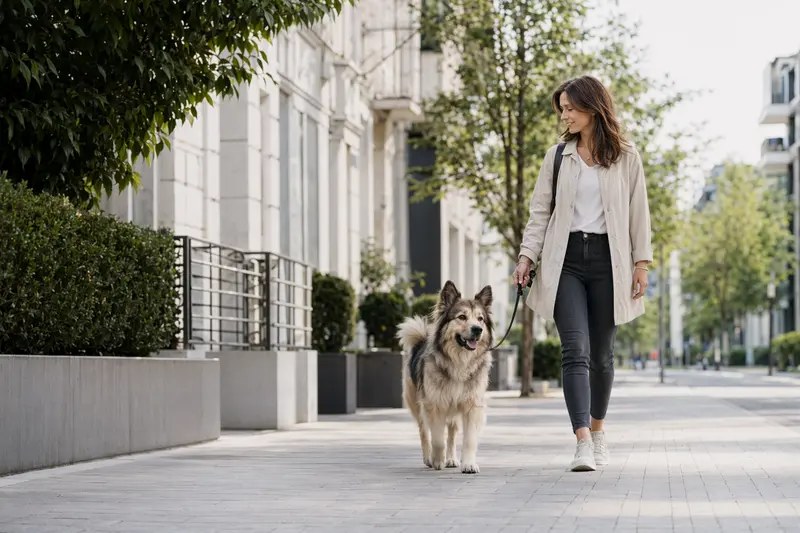
Living without a car in Los Angeles works until your dog enters the equation. A cat in a carrier can ride almost anywhere. A seventy-pound dog cannot. The vet is three miles away, the groomer is across town, the airport run is at dawn, and every option you actually have comes with a condition: a driver who may say no, a carrier rule your dog outgrew as a puppy, or a friend whose car and goodwill both run out. Car-free owners need a ride that is booked, not begged.
Key Takeaways
- Rideshare pet options cover one small pet at the driver’s discretion, which leaves big-dog owners gambling on every trip.
- Public transit in Los Angeles requires pets in enclosed carriers, so a large dog on a leash has no legal seat.
- A booked pet taxi is a confirmed vehicle, driver and price before the day arrives, not a hope placed at the curb.
- Standing rides for vet, groomer and daycare turn car-free pet care into a routine instead of a weekly negotiation.
Table of Contents
- [Why each fallback fails a big dog](#why-each-fallback-fails-a-big-dog)
- [The rideshare gamble, stated plainly](#the-rideshare-gamble-stated-plainly)
- [Transit and the carrier rule](#transit-and-the-carrier-rule)
- [What a booked ride changes](#what-a-booked-ride-changes)
- [Frequently asked questions](#frequently-asked-questions)
Why each fallback fails a big dog
Car-free owners usually rotate through the same three fallbacks, and each one fails in its own way. The friend with a car flakes, or helps twice and quietly stops answering. The rideshare driver arrives, looks at your dog, and cancels, and now you are late and standing on the sidewalk with a leashed shepherd. The bus requires a carrier that does not exist in your dog’s size. None of these is a character flaw in anyone. They are structural: every fallback was designed for a person traveling light, and a big dog is the opposite of traveling light. The comparison in Pet Taxi vs Uber Pet goes deeper, and Do Taxis Allow Animals? covers the ordinary cab rules.
The rideshare gamble, stated plainly
The Uber Pet page describes a tidy product: bring one pet, pay an added fee, ride. Read the conditions and the tidiness thins out. Uber’s own Uber Pet FAQ limits the trip to one pet, leaves additional animals to the driver’s discretion, and confirms drivers may refuse animals they judge unsafe or uncontrolled. For a calm cat or a small dog, that is a fair deal. For a big dog, every booking is a coin toss that lands at the worst moment, at the curb, with the appointment clock already running. Surge pricing on a rainy morning is the smaller problem; the refusal is the real one.
Transit and the carrier rule
Public transit is the honest option for a person alone, and it closes quickly for a large pet. Metro’s own Metro Micro FAQ states that Metro Micro cannot accommodate pets, with service animals the exception, and Metro’s wider rules require a pet to travel inside a fully enclosed carrier that does not block an aisle or take a seat. A carrier that holds a seventy-pound dog is a crate on wheels, and it is not coming up a bus step. Owners of small pets in carriers have a workable system. Owners of large dogs have a rule that politely describes a vehicle they cannot use.
The safety basics still apply to whatever ride you choose. The ASPCA travel guidance advises securing your pet in the vehicle, traveling with vaccination records, and keeping identification current, and the FDA guidance on traveling with pets adds that a pet should be used to its carrier or harness before the trip, not introduced to it on the day. Keep the rabies certificate on your phone; California’s CDPH pet guidance treats a signed, dated rabies vaccination certificate as the core document for a dog, and vets ask for it at check-in.
What a booked ride changes
A booked ride replaces the gamble with a schedule. I pick your dog up at your door in a full-size Suburban, where a large dog lies down in the cargo area instead of negotiating a stranger’s back seat. You ride along or hand the dog over, whichever the appointment needs. There is no driver discretion at the curb, because the booking itself is the agreement, and the price is set before the day: local rides start at $100, laid out in how much a pet taxi costs in Los Angeles and pet taxi rates.
That reliability compounds. A standing groomer run every few weeks, daycare on your long office days, the twice-yearly vet pattern from senior dog vet trips: each becomes a standing entry rather than a fresh favor. The mechanics are simple, and how a pet taxi works walks through a first booking. If the day turns urgent instead, emergency pet transport runs after hours too, which is the hour when car-free owners have the fewest options of all.
Our view: Not owning a car in this city is a reasonable choice that pet services quietly punish. Every fallback assumes a small, optional pet. A big dog is neither. My answer is unglamorous: a confirmed booking, a vehicle built for the dog you actually have, and the same driver every time, so car-free stops meaning care-limited. — Brian Ka, Pets Go Taxi
Frequently asked questions
Can I ride along with my dog?
Yes. Most owners do. You can also hand your dog over at the door and meet us at the clinic, or have the dog brought home to you, whichever the appointment needs.
My dog has been refused by rideshare drivers before. Will you take him?
Yes. Large breeds are the specialty, including strong and nervous dogs. Tell me his size and temperament when you book so the setup is right, and see transporting a large dog for how the load-in works.
Can I set up regular rides without owning a car?
Yes. Standing vet, groomer and daycare rides are a normal booking. We set the pattern once through the contact page and I handle the driving from there.
What does it cost compared with rideshare?
Local rides start at $100, confirmed at booking, with no surge and no cancellation-at-the-curb risk. A rideshare pet ride costs less when it works; the comparison that matters is against the appointment you miss when it does not.
Sources
- Uber Pet ride page
- Uber Pet FAQ
- Metro Micro FAQ
- ASPCA travel safety guidance
- FDA guidance on traveling with pets
- CDPH pet importation guidance